
THE LARRIKINS - PIONEER BUSH BANDI formed The Larrikins was back in 1971 with the expressed intention of having a group of singers and musicians who could perform Australian traditional material that I wanted to introduce back to the community. It was never intended to be a 'super group' in the style of The Bushwackers and I was determined it wasn't going to be a bush band. My close association with ABC radio and the arts touring organisation, Musica Viva Australia, played important roles in the groups' development. Without specialist programming or the incentive of national touring, the band would have found it difficult to expand its repertoire. The history of the band is fascinating. I am the remaining constant with Dave de Hugard, Cathie O'Sullivan, Bob McInnes and Jack Kevans being the longest-surviving members.
I mentioned that The Larrikins weren't a bush band. We were often described as such and, in truth, I never found anything offensive in the description. It was more about pre-conceived ideas and if people thought they were about to hear a bush band they would expect to hear the bush band Top 20 including 'Click Go The Shears', 'Maggie may', 'Botany Bay' and, at the time, 'The Rybuck Shearer'. We hardly ever sang these songs and as far as 'Walzting Matilda' was concerned, I was delighted when Dave de Hugard started to sing his version where the swagman, being a sensible type of cove, swam to the other side of the billabong, gave the squatter the two-finger salute, and disappeared into the scrub. We liked that twist and sang it often. I must admit that my memory is a little unreliable as to whom and when new members came in, went and sometimes returned. All I know is that between all of us we kept on the same creative path and produced some highly memorable radio programs and concerts.
DECLAN AFFLEY became an irregular regular in the band. What a singer and musician and what a stylist of traditional music this man was. We got on well and, depending on Declan's health and wealth, he moved in and out of the group. He didn't like leaving home for extended periods and this was problematic. One of Declan's great skills was that I could show him a song text and he could fashion a tune around it. Sometimes, as in the case of 'I've Been To Australia-O' the challenge was to get the tune to work with the difficult and erratic lyrics. Declan and I made a large number of radio programs and shared far too many beers. I certainly missed him when he died prematurely. The Larrikins had started to get booking from Musica Viva Australia, which, in the early seventies, was the world's largest Baroque music touring organization. Susan Gleeson, and later Trish Ludgate, looked after the coordination of the national school-touring network operating in association with the various Arts Councils. We became their group to represent Australian traditional music and we remained so for over twenty years. We would undertake two, sometimes three, regional tours every year and, over the years, managed to tour every state and territory in Australia where we undertook school performances in the day and evening concerts or bush dinners or woolshed dances for family audiences. These were heady times where we would be in outback NSW one month and on the Mornington peninsula the next. We toured the Simpson Desert, West Australia mining towns, Central Australia, Darwin and the remote mining towns surrounding her, Tasmania, the Victorian snow-filled mountains and the Mallee. [ continued . . . ]
|
RELATED ARTICLES Australian Folk Revival - A Potted History |
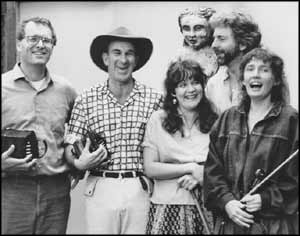 Larrikins The first members of the band were three Irishmen who were interested in learning Australian songs. Usually it is the locals who want to learn Irish songs. JACK FALLIS played guitar and had a fine tenor voice, PADDY MCLAUGHLIN played banjo and sang and NED ALEXANDER played a beautifully flowing fiddle. They were thoroughly decent chaps and we had some good times playing weekly at the St George's tavern in the Sydney Hilton and also regular gigs in The Rocks. LIORA CLAFF joined the group when a likely arts council tour was promising. TONY SUTTON, concertina and accordion player and singer, also started to do some work with the band. It was this first group that recorded one of my early ABC series, a three half hour program titled Navvy On The Line, and showcasing Australia's railway folk heritage. The series was successful and the Larrikin label eventually released the songs as an album of the same name. I guess this first recording of the group set the policy fair and square – the album mostly contained songs never before recorded. Mind you, they never sold that well either and that 's probably its own lesson.
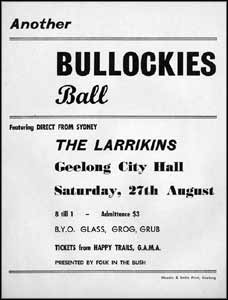 Jack, Ned and Paddy had their own Irish Band and after a couple of years they moved on. I knew the band needed to sound less Irish if I was to prove that Australian folk music “isn't juts Irish music that travelled to Australia” (this was the common belief). The fact is that our traditional music owes just as much, if not more so, to English and Scot's music. It was all a challenge and a matter of musical evolution.