
SOME FONDLY-REMEMBERED ‘BOY BANDS’ OF THE FOLK YEARS
|
IVY LEAGUE TRIOS
[Formerly published in Trad & Now, #26, 2008]l]
In 1958 a recently-formed singing threesome recorded an old Appalachian bad man ballad - and effectively changed the course of musical history. While scholars rightly point to the groundbreaking impact of predecessors like Burl Ives, The Weavers or Harry Belafonte, there is general agreement that the smash success of ‘Tom Dooley’ and its immediate successors marked the start of the great U.S.-led folk fad.
The Kingston Trio would go on to inspire or spawn a host of disciples and imitators. There were the inevitable boy-girl duos, family acts, Weavers-style quartets, big ensembles, PP&M homages, etc., but it was the male trio - relentlessly clean-cut, frequently campus-based, determinedly commercial and ‘crowd-pleasing’ in repertoire and orientation - which remains the most readily identifiable stereotype of the great 60s folk boom. The Kingston Trio reigned supreme but enjoyed particularly healthy competition from robust contenders like The Journeymen, the Chad Mitchell Trio, The Travellers Three and (at a more mature level) The Limeliters. For many a starry-eyed young folk fan the Ivy League trios were the boy bands of the era.
Just as the Australian chapter of the folk revival produced its quota of world-weary young blues singers, intense folk-poets, boy and girl collectives and piercing Baez-style sopranos, so it produced a not insubstantial array of collegiate trios which offered audiences in coffee lounges, hotels, Leagues Clubs, radio and TV an easy-listening (and usually non-controversial) mix of folk standards and stand-up comedy. This article recalls some of the more high profile such acts.
Arguably best-remembered is Western Australian trio The Twiliters which brought together three classmates from Perth’s Christian Brothers College, Jim Maguire. Kerry White and Hans Stampfer.
Kerry and Hans were still at school [recalls Jim Maguire]. I had just dropped out of Medicine at the University of WA and I was working as a psychiatric nurse. We originally set out to form a quartet singing pop songs. Then we heard The Kingston Trio ... that was a ‘flash of light in the sky’. Our first gig was the Senior School’s Christmas function ... To fit in with my shift work, we used to rehearse at 4.30 in the morning at Hans’ mum’s or in the boiler room of the mental hospital ... Then we chanced upon a little coffee shop, the Quitapena, in Hay Street ... Perth was just emerging out of the beatnik era. The eastern states had already moved on. [For a while] we used to hang around with bongo drums.
The Twiliters were resident act at the Quitapena (“the first actual coffee lounge in Perth, a very cosy place” with a seating capacity of 30-40) - off and on - for two years. Encouraged by DJ Keith McGowan, the boys won a regular spot on a local TV teen show Club 17, and played a round of country dances and hootenanny stomps.
At one show in Bundaberg, the police stopped the show because we sang a satire on the Profumo affair, ‘Profumo went a-courtin’. We toured country towns with Kevin Shegog ... We had our first taste of ‘something bigger’ when we were invited to appear on The Country & Western Hour in Adelaide. It was a thrill for young working class kids to stay in motels. Around then The Beatles arrived in Australia and The Twiliters received full Beatles treatment at a rock dance. They screamed at anything that was out of town. Later I remember playing at a rock concert in Fremantle where the locals preferred The Twiliters to Johnny Young! ...
At the end of 1964 we left Perth with 20 pounds between us. Hans hurt his hand and I was forced to pick up some basic guitar chords on the train to Adelaide where we were due to play on The C&W Hour again. (I already knew the banjo). I remember a non-stop party after playing a coffee lounge in Adelaide. We took part in a tour called FOLK 65 with promises to be paid at the end. Robyn Smith [Archer] was part of the tour but she had to be sent home because of asthma. At Mt Gambier we played a hall where, if more than 1000 people turned up, it was necessary to engage a fireman. As it turned out, only the fireman turned up. ...Then we moved on to Melbourne and we were introduced to Traynors ... We played table to table at Capers, at night spots like the Peppermint Lounge and on Kommotion. Then [at the start of 1965] Hans was accepted back into Medical School at the University of WA. He went back to Perth leaving us the ‘good guitar’.
With an enviable amount of work in the offing, White and Maguire elected to replace Stampfer. The new recruit was Greg Ferris, a Chemical Engineering drop-out, 12 string guitar whiz and former musical partner of Dick McKay. (Dubbing themselves The Travellers, Ferris and McKay had been grounded in the infant Hobart folk scene - sometimes performing with Patsy Biscoe - before hitchhiking and ‘singing for their supper’ around New Zealand then across to - and throughout - WA). “Greg fitted in really well. He played a different style to Hans and the group quickly established a new spirit “. The Twiliters quickly relocated to Sydney. “We recognised that to survive we were going to have to make it commercially. The club circuit taught us how to construct a good set, how to move audiences”. Within 6 months of Ferris’ arrival, the trio was being dubbed ‘Australia’s foremost folk group’. The Twiliters attained a peak of popularity in 1968 when they supported Marlene Dietrich at the Adelaide Festival of Arts and on tour, and followed up the success with a well-received ABC TV series Good Grief It’s the Twiliters.
 Recordings by The Twits (as the trio was dubbed, usually affectionately) indicate the strong influence in style and repertoire of American group The Journeymen. (The Journeymen combined Dick Weissman, Scott McKenzie who would score solo fame with the flower power anthem ‘San Francisco’, and John Phillips who went on to form The Mamas & The Papas). Journeymen favourites like ‘Wagoner’s Lad’, ‘Me and My Uncle’, ‘Bethlehem’, ‘Chilly Winds’, ‘Dark as a Dungeon’, ‘In the Evening’ and Phillips’ post-folk ‘Go Where You Wanna Go’ were covered unashamedly - and effectively - on 2 albums, The Twiliters in Concert and Great Day with the Twiliters for RCA, as well as a handful of singles and a couple of EP tie-ins with the TV show. Other highlights include stirring versions of ‘The Ox Driver’ and ‘Albury Ram’, Adelaide writer Phil Sawyer’s poignant ‘Thanks for the Hand to Hold’, and the whimsical ‘Creamsleeves’. The trio disbanded at the end of their TV series (partly because Maguire had returned to University). An offer of a tour of the Top End and American bases the following year brought them back together, disastrously as it turned out because of Ferris’ mood changes and obvious health problems. He was flown back from Malaysia to Sydney where he died (in January 1970) of a previously undiagnosed brain tumour. (Today, ex-Twiliters Stampfer and Maguire both practice as psychiatrists, in Perth and Sydney respectively. Kerry White died - too young - in the early 1990s). Notwithstanding the sadness of its conclusion, Maguire (in an interview a couple of years ago) recalled the trio with enormous affection:
We had a lot of fun ... We weren’t too caught up in the technicality of the music . Each of us was complementary. Kerry was head and shoulders above us as a singer. He was very good at organising the harmonies. Greg worked out the guitar arrangements . My role was being the talking head ... Everyone felt they were contributing ... We loved being on the road ... We were little affected by folk scene debates ... My favourites of our recordings are ‘Chilly Winds’ with its Byrds-style arrangement, ‘Great Day’, and Kerry’s wonderful vocals on ‘In the Evening’ and ‘The Wanderer’. I’m also pleased with ‘Shades of Grey’.
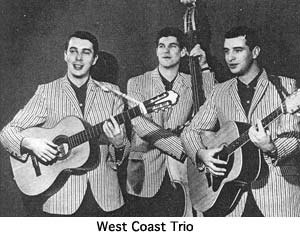
The Perth scene produced several memorable ensembles. While it failed to achieve comparable national success, The West Coast Trio rivalled Maguire, White & Stampfer/Ferris on home turf, attracting its own coterie of loyal fans across town at The Shiralee in Howard Street.
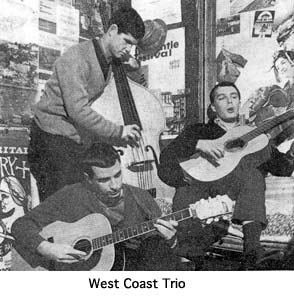 The Shiralee attracted a yuppie element [and] the real folk enthusiasts [maintains Hans Stampfer]. The Quitapena was more a real restaurant. The Twiliters appealed to the teen market [whereas] The West Coast Trio was more up-market ... We were pop folk stars... They were more sophisticated musically although they didn’t have the same raw energy ... The WCT was influenced by The Limeliters and were generally more in the style of The Wesley Three. The Twiliters combined the more accessible stylings of The Kingston Trio and captured a certain pulse and feeling.
The WCT teamed student teachers Nick Melidonis and Mike Robinson and law clerk Murray Wilkins.
The group lasted from 1961/2 to 1966, through my university years and my first year teaching [remembers Melidonis]. We had worked up a few folk pieces when we were picked up by ABC producer John Tyrrell who put us on air and later featured us on the ABC TV series Folk Cellar. Tyrrell was an ex-Shakespearean actor; he taught us how to perform rather than just play ... Murray was an excellent comedian ... Our repertoire was a mix of American songs like ‘Old Dan Tucker’, comic songs like Shel Silverstein’s ‘Espresso’, settings of poems by [WA folklorist] John Joseph Jones or Dorothy Hewett, and international stuff, flamenco, Brazilian songs, etc ... The fishing song ‘Curimao’ won praise from Eartha Kitt when we supported her at the Capitol Theatre ... We played at the Fremantle Spring Festival and sang at civic functions at Government House and at a big variety concert in the Supreme Court Gardens. We also played Sunday evenings at the Foxhole, on the corner of George and Hay Streets, and at Floridata in Wellington Street, the only nightclub in Perth. Perth was still a country town then ... We featured in 3 series of Folk Cellar, along with James Smillie, The Yellowstones and Bruce & Romanie Williams, and we started the University of WA Folk Club ... A real highlight was a Town Hall concert with the Andre De Moller Trio.
During the long university summer break of 1964/5 The WCT emulated The Twiliters by heading east (with Wilkins’ double bass strapped, coffin-like, to the top of the car), playing country pubs, Leagues and RSL clubs, and TV shows like In Melbourne Tonight and The Diana Trask Show. For a while the trio evolved into The West Coast Four with the addition of [ex-Twiliter] Hans Stampfer. Then when work and study pressure forced Robinson and Stampfer to leave, it was back to a trio with visiting student Zaid Aliff. In 1966. The WCT made the finals of the nationally-televised Showcase series with their rendition of ‘Darlin’ Corey’; unfortunately national exposure backfired when it was discovered that Aliff was in the country illegally. He promptly went “underground” and The WCT disbanded. (For a while Melidonis worked in a duo with singer Rod Popham; a professional photographer, he remains active on the Perth music scene up to the present). Unlike The Twiliters, The WCT did not leave a vinyl legacy; their only record was a live custom pressing of ‘Ella Speed’; Melidonis notes, however, that a tape of the trio’s last TV gig, an ABC Special Meet the West Coast Trio still exists.
Also worth recalling is The Wayfarers (not to be confused with the longlasting Brisbane ensemble of the same name). The youthful ensemble included Kerry White’s brothers Vic and Kim (16 and 14 respectively) and 20 year old Wayne Garton; their impressive takes on PP&M material earned them second place in their heat of Showcase 65 but further success was vetoed when Garton’s number came up in the first Federal conscription lottery. [*For further detail on the early WA folk scene, see my article ‘Recollections of the Folk Boom in Perth’, published in the WA Folk Federation newsletter Town Crier, vol 32(5 &6), 2004; vol 33(1&2), 2005]
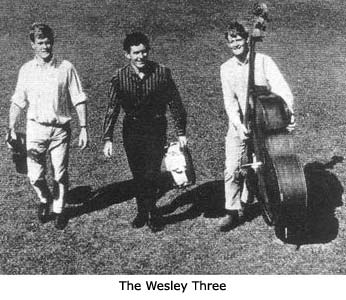 Second in national popularity to The Twiliters was Adelaide trio The Wesley Three, a stylish, musically knowledgeable ensemble which attracted public attention through national appearances on Showcase 65, and recorded 4 albums for CBS: The Wesley Three, City Folk, Banjo and Mr Thwump, Leaning on a Lamp-post. Formed circa 1963 when Keith Conlon and twins Peter & Martin Wesley-Smith were still at St Peter’s College (“performing paid our way through university”), the trio cited the Chad Mitchell Trio and, more directly, a local pop-group, distinguished by its use of snare-drum, the Dave Fuller Trio. With Conlon on drum, Martin on guitar and Peter on string bass, the trio survived six years until Peter went overseas to do post-graduate work. Their repertoire encompassed the occasional bush ballad (‘Flash Jack’), American perennials (‘Drill Ye Tarriers’, ‘Little David’, ‘Bullgine Run’), vaudeville material (‘Leaning on a Lamppost’), mild social comment (‘Little Play Soldiers’) and children’s songs (a lovely ‘Owl and the Pussycat’ and an original ‘Little Tommy’ which was covered by the American group The Serendipity Singers).
We sang at parties and at school and in 1964 made our first appearance on Channel 7, also on Channel 9’s Adelaide Tonight [recalls Peter Wesley-Smith] . We played at The Catacombs while we were still at school. Keith also played with the Campus Six ... There was a big crossover between jazz and folk. The University Jazz Club brought Paul Marks over ... Because Adelaide was such a small scene, it made sense to combine venues ... we went on to appear on IMT and Showcase. We travelled to Sydney for three weeks each year, doing the coffee lounge round, the Last Straw and the Copperfield, and so on. It was heady stuff for young Adelaide kids in the 60s. .. [Promoter] Jim Carter still owes us for one gig - the Katoomba Festival - which was a complete failure. The whole area was enveloped in fog; Acoustically it was wonderful but you couldn’t see anything but a few lights twinkling ... .. Both Martin and I were conscripted in 1965; we managed to have it deferred because of university and we continued studying. I combined Arts/Law and Honours, then got a special exemption to do a Ph.D. However, the spectre of conscription was over our heads. We had planned to take a year off to debvote to music but it wasn’t possible because of the draft. Going overseas to study [in 1968] meant the end of The Wesley Three.
Listened to today, The Wesleys arguably remain the best of the U.S.-style trios by virtue of their musicality and originality. (Martin Wesley-Smith went on to become a leading exponent and composer of electronic music; Peter Wesley-Smith was , for some years, Dean of Law at the University of Hong Kong. Another brother, Jerry [Wesley], is a respected jazz musician in Adelaide; in 1971 he Jerry and Martin teamed with Keith Conlon and actor Amanda Hodgman for a recording The Glorious Years, released by Jacaranda Press in conhjunction with the book of the same title). Another Adelaide band The John Gordon Trio “took off” briefly after appearing on Showcase 65, performing at hotels, Leagues and RSL clubs, and the bigger coffee lounges. The trio reportedly combined a folk sound “with a lot of comedy and hokum thrown in”.
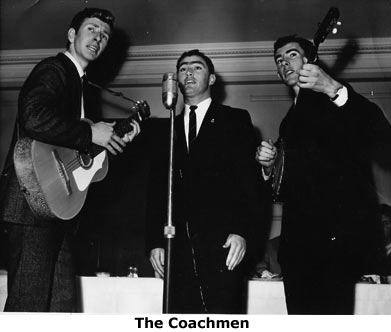 Well-regarded on the Melbourne scene were The Coachmen, resident act in 1965-66 at the Colonial Inn in suburban Kew. Typically, Jim Kenny, Ron Cahill (later Chief Magistrate of the ACT) and John Wintle started playing while at school together, circa 1961.
I was turned on to folkmusic by The Kingston Trio [recalls Kenny]. I made my own guitar out of a door-frame - open tuning. I also constructed my own banjo. We played at parties, charity dos and dances ... even had a youthful manager. Then we appeared on Christies’ Auditions on 3 UZ and earned three gongs. A lot of folkies tried out there. Through [presenter] John McMahon we played at foster homes, boys’ homes, Year 12 concerts, etc. I remember being stunned when we were paid 25 pounds for doing three songs as a Gas & Fuel Company luncheon. In 1964 we played our first coffee lounge gigs ... two or three sessions at Prompt Corner, from there to the Copper Kettle. The Seekers, Garry Kinnane and The New World Trio also played there.... The Colonial Inn was two converted shiop fronts near Kew Junction. It served food – Welsh rarebit, cinnamon toast - but was never really a restaurant. On a standard night The Coachmen went on at 9.00. Maybe four brackets a night. Hans, the owner, wanted quantity not quality ... We did lots of requests: Trad stuff, Dylan’s ‘Oxford Town’, Kingston Trio, Australian songs and some of our own ... There was a back room where those who were really keen could go to listen silently to the singing. It sorted out the really serious from those wanting a night out ... Our other gigs included Showcase 66, New Faces ... A highlight was playing a concert at Assembly Hall with Margret Roadknight and David Lumsden. Lumsden’s banjo-playing was a strong influence, so were Mooney, Wyndham-Read and Alex Hood ... The group folded when we left university and went to work [1967].
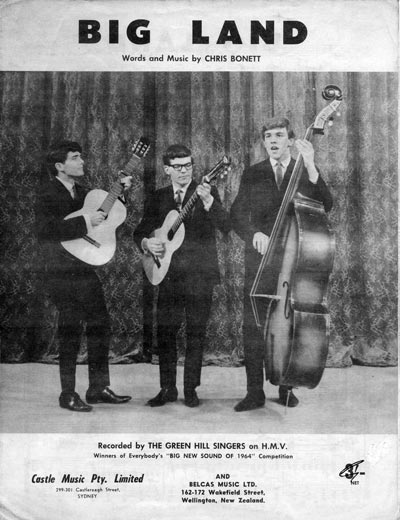
Another Melbourne-bred trio found a broader audience - and the proverbial ‘fifteen minutes of fame’ - by moving to Sydney. “I make no apologies for the fact we tried to copy The Kingston Trio, with the ivy-league shirts and the whole thing”, remembers John McMillan, leader of The Green Hill Singers. “As far as we were concerned, we wanted to just make music ... The beauty of it was working alongside the Marian Hendersons, the Declan Affleys and the Danny Spooners”. McMillan, his brother Alec and schoolfriend John Jenkinson had earlier enjoyed minor success, as The Vedetts, appearing every Sunday night on Dick Cranbourn’s 3UZ Radio show. Early in 1964 the McMillans teamed up with bass-player Chris Bonett and “it just all clicked. Chris was the talent we had to have to form a trio as we wanted it”. As The Green Hill Singers, the boys played on In Melbourne Tonight (IMT) and had the distinction of succeeding The Seekers as resident group at the Treble Clef in South Yarra. Winning Everybody’s Magazine’s ‘Big New Sound of 1964’ talent quest gained the trio a recording contract with HMV and a season supporting Shirley Bassey at the Palais in Melbourne and Chequers in Sydney. A single ‘Big Land’, a catchy celebration of the outback penned by Bonett, received substantial airplay, and the boys threw up their day jobs and moved to Sydney to appear regularly on the ABC TV series Jazz Meets Folk.
Throughout 1965 The Green Hill Singers teamed work in the folk clubs (including the Carter venues) with gigs at RSL and Leagues clubs and appearances on Bobby Limb’s Sound of Music and Dave Allen’s Tonight Show. For a while, they were flown down every Friday to play on Noel Ferrier’s IMT, and at mid-year they recorded an LP for Festival, The Folk Sounds of The Green Hill Singers. John McMillan remembers the trio’s excitement when Dave Guard was called in to provide instrumental support on several cuts: “Am I dreaming here? This is the man I went to see in concert [i.e. with The Kingston Trio]. He’s sitting here in the studio playing 12 string guitar and banjo”. An even bigger thrill was meeting Peter Paul & Mary “at Gary Shearston’s flat at St Peter’s, and having Paul Stookey walk in, sit down and play guitar with me”.
Interestingly, Guard’s interest in the trio heralded a decisive personnel change. In the middle of recording the LP, he ‘head-hunted’ Bonett to appear in his own (Guard’s) group on the TV series Dave’s Place. Brian Godden was brought in to fill Bonett’s place and finish the album (which “sank without trace”). McMillan believes The Green Hill Singers was never quite the same without the versatile Bonett, and the trio disbanded, due to lack of work, in November 1965. (The McMillans played occasional m.o.r. gigs at restaurants for a couple of years. Godden subsequently toured extensively as backing instrumentalist for Alex Hood).
At a time when opportunities to record were significantly fewer than they are today, it is surprising how many of the male trios managed to ‘crack’ the record market. Among the other “Kingston Trio clones” sufficiently successful to actually make it “onto vinyl” (to greater or lesser extents) were The Tolmen, a Sydney-based ensemble comprising Gordon Tolman, Geoff Turner and Lew Jones, who raised eyebrows within the folk fraternity when they were selected by the Arts Council of NSW for a sponsored tour of country towns and schools in 1964. The Tolmen released 2 EPs, Pieces of Folk and Namatjira, and a single ‘Don't Book Me Officer’, on RCA.
The Lincoln Trio unselfconsciously sported matching icecream jackets and specialised in upbeat favourites like ‘Midnight Special’, ‘The Queensland Drover’ and ‘O’Reilly’s Daughter’. Led by trainee business executive Brian Tonkin (the other members were Sean Flanagan and Gary Pearson), the trio recorded a single for RCA, ‘Wimoweh’ b/w ‘Go Lassie Go’, before disbanding when Tonkin’s firm sent him overseas. The New World Trio, comprised of Mel Noonan, John Kane and John Lee, attracted favourable attention with their folky version of ‘Feed the Birds’ (from the film Mary Poppins), and released several folk-pop singles (‘The World I Used To Know’, ‘Tom Tom Turnaround’, ‘Try to Remember’, etc) before and after reincarnating as the more m.o.r. New World. The Nomads Three (Walters, Grace & McCarter), a trio from Newcastle and stalwarts of venues like the Folk Sanctum, Adytum and the Purple Parrot, preserved their versions of Gary Shearston’s ‘The Voyager’ and the Mitchell Trio’s ‘Hang on the bell Nellie’ and several bush ballads the albums Folk Songs from Around the World and Faces in the Street for the local Vista label. The Norfolk Singers mixed classics like ‘The First Time Ever’ and ‘Whiskey in the Jar’ with topical drollery like ‘Nasho Service’ and ‘The Opera House is Falling Down’ in a batch of singles for CBS. Melbourne-based pop threesome The Unichords tapped into the nascent folk boom by remodelling itself as The Southern Folk Three for an album, Gotta Travel On, on W&G, and subsequently, as The Billabong Three for Outback, an EP of bush songs commissioned by the Golden Fleece Petrol Company. More modestly, The Coachmen produced a limited issue LP, privately pressed for St Francis’ Church, which included a self-penned civil rights lament ‘The Long Hot Summer’.
 In terms of long-term influence and/or groundbreaking contribution to the evolution of the Australian folk revival, the commercial male trios are hardly of primary importance. At the time, they were regarded with varying degrees of disdain by the so-called ‘real folksingers’ and the folk establishment amid claims they were diluting or synthesising folkmusic for fame or gain - or as mere “entertainment”. Eminent folklorist Edgar Waters once dismissed The Wesley Three as “gimmicky undergraduates” likely to appeal to people who liked their folksongs sung by a “Village Glee Club”. (For Wendy Lowenstein of Australian Tradition, the Wesleys’ relevance was “at most ... marginal”). Peter Wesley-Smith recalls purist criticism at The Wesley Three’s unauthentic approach and their failure to sound as if they “had dug potatoes” with some amusement. (“I can see a case for establishing your categories but to allow the categories to dominate everything is the height of foolishness”). “There was a strong delineation between the ‘true faith’ and those seen as ‘exploiting’ it”, notes Jim Kenny. Likewise, the collegiate trios failed to impress those earnest souls who insisted there must be a fundamental nexus between folksinging and socio-political activism. The Twiliters, for instance, deftly avoided overt political material (the comic ‘With You All the Way LBJ’ was an exception); their conservative image was underlined by their willingness to entertain Australian troops in Vietnam. Peter Wesley-Smith notes:
We were very much non-political as was the Adelaide scene generally. As an indication of how naive we were, we wrote a song about a strike at Holden Motor Works taking the side of management! We played it and only one reviewer objected. The Wesley Three did do some stuff in the protest vein but we weren’t passionate about politics ... I recall that Gary Shearston didn’t like our version of ‘The Voyager’. They were very naive times, at least until Vietnam took off.
By extension, it is hardly coincidental that mainstream churches played something of a nurturing role in the careers of a number of the male trios. Just as The Twiliters found their first audiences at Christian Brothers College in Perth, so The Coachmen’s first paid gigs were through their local parish. “Folkmusic was deliberately cultivated as an alternative to rock’n’roll. We were three good Catholic boys who sang wholesome stuff”, recalls Jim Kenny. Similarly, The Greenhill Singers played around the Melbourne Presbyterian church network before ‘hitting the big time’. One Melbourne trio, The Glen Men, actually brought together three trainee priests. (The trio recorded an EP for W&G The Wonderful World of the Glen Men).
In hindsight, however, a sampling of recordings of the era confirms that contemporary critics often failed to acknowledge the skill, fervour - and undeniable affection for the material - displayed by the best of the collegiate trios. While the recordings - and the crowd-pleasing approach taken by the artists - clearly belong to an earlier, arguably less discriminating phase in Australian audiences’ folk consciousness, I suggest that they testify to a musicality and verve that continue to render many of the performances both enjoyable and still valid.

 ©2004-7 Warren Fahey | website designed by Mountain Tracks © 2004-7