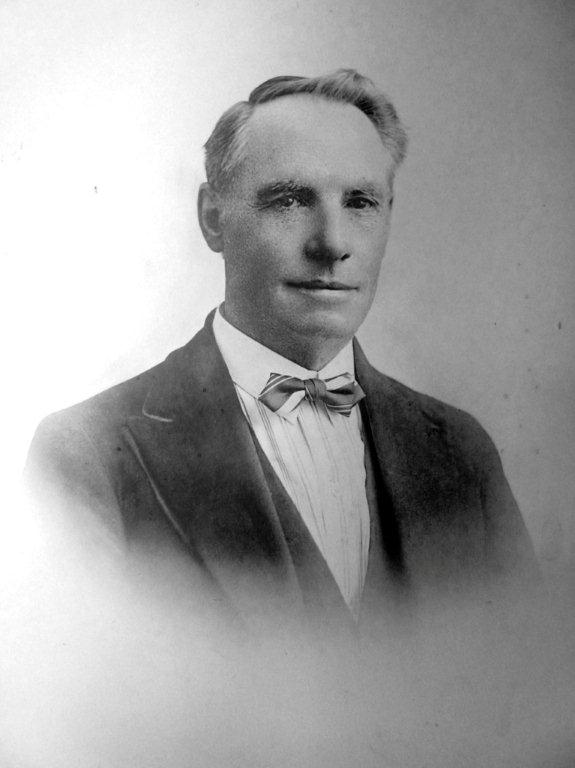
SCHOOLS OF THOUGHT - The Life and Writings of Will CarterBy Ron and Catherine Frew© Warren Fahey 2010 I have lost count of the year I first came across the poem Tumba-bloody-Rumba about the bushman who, after being a shearer, rabbit trapper, stacker and a few other jobs to boot, ended up 'shooting kanga-bloody-roos at Tumba-bloody-rumba". It would have been in the early 1970s and it led me to John Wolfe, a local poet, who swore black and blue he wrote it. We had a bit of correspondence and John gave me the green light to put his poem to music. I did, and have been singing it ever since. Here's John Wolfe's version. TUMBA-BLOODY-RUMBAHe asked for work at muster-time, He said he'd shorn a sheep or two, We had him in the shearing shed, He never showed his aptitude, We tried him cutting fencing posts, (A recorded version appears in my ABC Music CD series and the music notation in the accompanying book 'Australia: Its Folks Songs & Bush ballads') A recently published book on Will Carter now has me confused over the authorship of the poem. More likely there have been more than one version of the poem floating around and, as often the case, people add a verse, change a few things, and claim it as their work. These versions are, of course, correct in some degree and this is often the way oral transmission of folk song and poetry works. In their introduction to the book the Frews point to the Tumbarumba poem as having a life of its own and one possible contender, because he was an active poet, was their subject, Will Carter. This was not to be the case and the Frews point to the original version, or possible one of the original versions was more likely the work of John O'Grady, best known for his work as 'Nino Culotta' and 'They're A Weird Mob'. In a round about way the Frews chasing of the Tumbarumba poem led them to Will Carter. Will Carter was born in 1867. With a life of 88 years he spanned significant changes in Australia. The gold rushes tripled the population; gold was replaced by the new fortunes of wool, wheat, beef and coal; our colonies had federated to become a nation; the population had shifted to living primarily in the cities, and we had seen ourselves fighting in WW1. Carter, like many of his time, was interested in the development of the Australian identity. Carter was a prolific writer and Ron and Catherine Frew have used his words to provide us with a unique insight into one man's vision of Australia. Carter was a schoolteacher and, in his way, a documenter of life. He contributed to local newspapers and The Bulletin. He was also an accordion player, bush dance MC and a dab sketcher in the style of Hop and Lindsay. Back to Old Sofala
Said young Sofala Present unto old Sofala Past, As a contributor to The Bulletin he used several pseudonyms, mainly 'The Prooshan'. 29 March 1906 "The Prooshan" : Many bushfolk claim that snakes have a dislike for the smell of geraniums – so great that these plants, set liberally round a house, prevent the undesirable reptile calling in. Another piece was of particular interest to me as it contained a bullocky's call. These calls, usually containing the name of the bullocky's horses or bullocks, were used to goad the beasts on in their work. I must admit to a fondness for these calls as one of the very first people I ever taped was a retired teamster who impressed me with his love of his team. 'The Prooshan' 31 January 1907, Re: 'the Prawn's' comment (B. 10/1/07) on my bullock nomenclature par. I spoke of everyday bullock-punching names. Certainly there are faddish or freakish bullock-punchers. One I know plied between Tumut and Tumbarumba. He love the sea and all that on it had been, from Ulysses right along; and, punctually at 3 o'clock o' Mondays, we'd hear, from t'other side of 'our hill', "Gee Nelson, Woa Rodney, up Drake, Come-e-way Howard. Stand over Hawkins, Over there Raleigh." Then we boys drifted down with poles to prod Nelson in the ribs, or give Howard of Effingham a belt across the rump, and so help the load up the hill. One of the things that fascinated me about The Bulletin was the fact that they actively encouraged people like Carter to contribute. The rule of thumb was that the magazine welcomed contributions of up to 300 words. In a way this gave the readers a certain 'ownership' of the magazine and, in its way, encouraged writers. I thought this book might be yet another local history collection but it is far more than that. It's a fascinating journey through the eyes and work of a little-known bush scribe that has been put together in an intelligent and readable format that salutes history and bush poetry. There are some cracker old photographs featured in the book and I especially like the one on page 51 showing the Courabyra School Picnic luncheon, 18 March 1904. A grand affair! One disappointment was the fact the Frews could not locate a photograph of Will Carter and his button accordion. Oh well, at least the man has been put down in print again and his life documented for the future.
|
IN THIS SECTION:
WILF CARTER
OF INTEREST: You can purchase the book by mail order directly from Ron and Catherine Frew at Will Carter's manuscript collection is housed at the Mitchell Library, Sydney, MLMSS3372
|