A PORTRAIT OF A SYDNEY SUBURB
Paddington born. Paddington Bred.
Thick in the arm and strong in the head
(old saying of George Patrick Fahey)
[previous . . . ]
© Warren Fahey 2008
Looking up Oxford in 1860 at around Elizabeth and Regent Streets you would have seen a muddy road, a few modest houses and the Paddington Inn (previously the United States Hotel). This was the venue for the first Paddington Council meeting! The hotel still stands on the corner of William and Oxford streets.
Paddington was also known for its Windmills used for flour and other grinding work. The first windmill was erected by the aforementioned Mr West, who supplied Governor Macquarie with ground wheat for his daily bread. West eventually closed his mill and opened a large dairy farm in Paddington.
It was the custom in 1820 and 30 that each night at 6pm a bell was tolled on College Street and Head Street (now Oxford) advising females that they were not allowed to enter the area of Paddington, at night because of the rough nature of the suburb.
Darlinghurst Goal was opened in June 1841 and its first inhabitants were marched to their new quarters from their previous abode in Lower George Street, chained together.
Originally the Goal was divided into two portions – the male division containing 407 cells, and 39 cells for females, all in all 446 cells. At times it has been the home of some of the worst criminals. It is interesting to recall that no fewer than 70 prisoners were executed within its walls. The last execution took place on October 29th, 1907.
Francis Greenway was commissioned to design a goal that would overlook Sydney as a constant reminder that Sydney was a convict town. Convicts from 1822-1824 built the walls of the jail. You can still see convict marks on them. The marks were made to show how much work each convict did. Greenway's plans were used for the walls. But because he was an ex-convict, he was taken off the job and his plans for the buildings were not used. Instead, the jail was built using the plans of a jail in Philadelphia. The Plan of the Goal was like the spokes of a wheel, with wings radiating from a central point leaving narrow segments of space between. Work began on the jail in 1835 and it took 50 years to finish. By 1840 the Governor's residence, one men's cellblock and the women's cellblock were ready. To move in, the prisoners walked through the streets of Sydney from their old jail at Circular Quay to the new goal. The first governor was Mr. Henry Keck.
 All classes of criminals from the quietest to the most desperate have been dealt with inside Darlinghurst Goal. All classes of criminals from the quietest to the most desperate have been dealt with inside Darlinghurst Goal.
In bygone days bad prisoners were sent to dark cells and wore strait jackets, the gag and irons. ‘In the last 25 years, only two prisoners succeeded in effecting an escape from the goal’. (Truth Newspaper 1914 ‘Old Chum’).
Frank Gardiner, one of New South Wales’ most renowned bushrangers was accommodated in Darlinghurst Goal, as the fiasco surrounding his trial became public entertainment. For more information (and songs) on Gardiner (aka Frank Christie) visit the site’s Bushranger section.
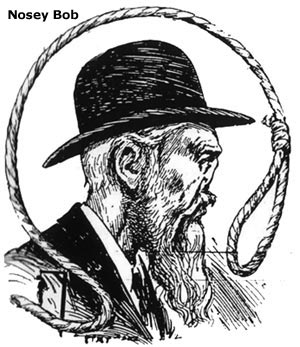
‘Nosey Bob’ (real name Robert Howard) was the State’s first official hangman, officiating at his last execution in 1904. He is buried at Waverley Cemetery.
Darlinghurst Goal then remained the main Sydney penitentiary up until 1914, when it's unwilling inmates were transferred to the new "model prison" at Long Bay. During its long life, Darlinghurst Goal hosted public executions on a makeshift gallows outside the main gate in Forbes Street, as well as regular "private" executions on the permanent gallows just inside the main walls near the intersection of Darlinghurst Road and Burton Street. Over 70 people were executed here including the bushranger ‘Captain Moonlight’ (aka Andrew George Scott), Jimmy Governor (known as ‘Jimmy Blacksmith’ in more recent times), and the last woman to hang in NSW, Louisa Collins.
Henry Lawson also did time at Darlinghurst, for drunkenness and non-payment of alimony, and recorded his experience in the haunting poem ‘One Hundred and Three’ - his prison number- that was published in 1908. Here he refers to the prison as ‘Starvinghurst Goal’ because of the meager rations given to the inmates.
At one time Darlinghurst Goal was the principal manufacturing goal in New South Wales. The chief industries carried out were mat-making, tailoring, bookbinding, blacksmithing, boot making and carpentering.
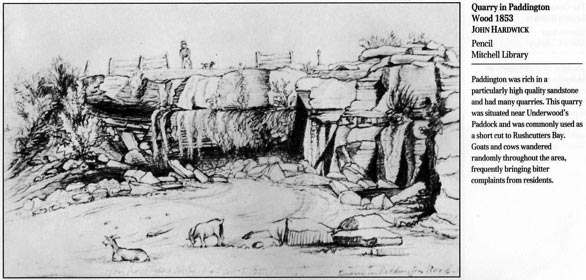
One of the most dominant sights in Paddington is the Army compound known as Victoria Barracks. It was begun in 1841 and used a local stone quarry engaging a large number of convict quarrymen and 100 imported Canadian stonemasons. There were massive delays because of the sand hills and it took three times longer to complete than anticipated. The Victoria Barracks were completed in 1848 and first occupied by 11th regiment.
When the first troops were transferred there several of the soldiers complained that they were being sent to ‘the interior’ and too far away from ‘Barrack Street’. There was considerable grumbling as they thought they wouldn’t be able to get into town at night and, they objected to living next to the scrub.
The site was chosen as being strategically placed between Port Jackson and Botany Bay in the event of enemy invasion. It is still used as a military barracks today.
Other Signposts to History
The Green Gate Hotel built for these workers. It later became The Greenwood Tree. Nearby was the Nag’s Head Hotel. This hotel was situated on Oxford Street, opposite the Barracks and in front of part of the old hospital. It is now a retail complex with little to remind us of its history.
A toll bar crossed the road on Old South Head Road (which is now Oxford Street) and later moved to near the barracks. It was eventually abolished around 1880.
Thomas Mort made his first ice experiments in Paddington. He was determined to manufacture ice for his frozen meat business housed at Mort’s Dock. Mr Mort also financed the Sydney to Parramatta railway in the 1850s (Refer to this site’s railway section for a complete history of transport in Australia and this 14 mile railway). Mort’s Dock Balmain became a major shipping dock.
The First Paddington Council was established in 1860 and the rate book shows 649 properties of which 500 were houses. Mr Perry (Arnott was first Mayor) - he lived near the Fairfax residence at Double Bay.
[NEXT . . . ] |
