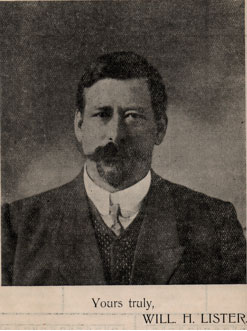
MOLEY HOSES!THE STORY OF WILL H. LISTER - AUSTRALIAN BUSH HUMOURIST
|
| ‘An effort has been made throughout to cultivate a bright genial spirit, and if the perusal or recitation of the sketches should in any way serve to excite merriment, and enable the weary to lay aside, for the nonce, the worries and cares of life, the object of the writer will be accomplished.’ |
Garbled English, often referred to as ‘broken English’ is a fascinating study and appears to have been a part of popular Australian entertainment for quite some time, probably originating in English vaudeville and landing here during the 1850s goldrush. It is no coincidence that many German immigrants came to search for gold.
Although they seem to have disappeared the most common forms of Australian broken English were German, Dutch, Yiddish and Aboriginal so called ‘pigeon English’.
Mark Schuster has done considerable work on German traditions in Australia, including several oral history recordings for the National Library, and has been very generous in my own research into Will H. Lister. Mark is himself of German background and explains that gemixt idiom is regional, and referred locally as Barossa Deutsch; Lockyer-Deutsch; Fassifern-Deutsch etc. and that the regional German-English languages were subtly different. ‘Some had a large smattering of 'low' (Platt) German words embedded. One or two variants would be very hard for us to understand. Most people spoke the Platt - whereas 'Hoch' Deutsch was used for schooling/Church.’ Mark reinforced that the majority of German settlers had a good attitude to life, enjoyed drinking, socializing, music and joke telling. One can imagine the pioneer families, with a smattering of English, trying to communicate with the dry-as-a-bone Australians, and the invention of a humorous broken German/English would have produced laughter on either side of the fence. Much of our pioneering spirit could be summed up as ‘what else could one do but laugh’.
The term ‘double Dutch’ will be familiar to many readers. Dutch, like German, is a guttural language and presents certain difficulties in pronouncing words like with which becomes mit, where becomes dere and they becomes dey – and these examples are only the easy ones! The Jews were a popular target for humour and, considering the number of Jewish stage performers in London, Manchester and New York at the end of the 19th century, it is interesting to note that much of the seemingly racist material emanated from their own acts. One of Australia’s most gifted and popular entertainers, Roy ‘Mo’ Rene, was a Dutch London Jew (his real name was Van der Sluice) from Adelaide and much of his humour was based on Yiddish put downs, including songs. Aboriginal ‘pigeon’ was also a point of humour and references also appear in songs like the final verse of The Old Bullock Dray’ and ‘Old Black Alice’. Most of the Aboriginal material was of the ‘Witchetty’s Tribe’ variety in as much as it was condescending and would be thought inappropriate nowadays.
One of the questions arising from these various groups is whether they were seen as racial slurs. The Germans and Dutch broken–English songs, jokes and monologues do seem to place their subjects as dumbkofs or bumpkins. Lister’s ‘Heinrich Schmertzer’ and his German associates are not portrayed as fools but as kind, sometimes bumbling, pioneer settlers facing the usual rural challenges but addressing them in a German Australian comic way. They also express a passionate love of Australia, something most native-born Australians found it difficult to express. Lister’s works also point to a concern over the, at the time, growing disquiet in Europe over Germany’s imperialistic moves. This must have been a difficult position for German Australians and, of course, news from Europe to the backblocks was unreliable, usually out of date, and prone to misinterpretation.
A pioneer of German broken English song was J.Emmet who was an Adelaide-based vaudeville artist. His Emmet Songster, published by Coles Book Arcade (Adelaide Branch) in 1877, included such titles as ‘Schneider, How Vas You?’, ‘Shonnie Vos A Nice Young Man’, ‘De Vatercress Girl’, ‘Sauer Kraut Recipe’ – all sung by his internationally renowned character ‘Fritz’.
Many Germans came to Australia for the goldrushes and German named towns and landmarks cover Australia. I was curious why Will H. Lister would have chosen to work with a German character (if he himself was possibly not of German extraction) and Mark Schuster explains some of the background to German immigration flows:
‘Germans came to Queensland because of the immigration agents (Heussler) who roamed the northern German countryside/billboards. We need to remember the colony of Queensland had its own immigration agents. Squatting runs were broken up in the 1870s/1880s. Prior to this shepherds were needed; post 1880s selectors were needed when the 'runs' were broken up resulting in enormous immigrations through Moreton Bay and Maryborough. I know of many Tenterfield settlers coming from Brisbane. Grafton and Hunter Valley Germans were vine dressers/tradesmen from Central Germany. Riverina settlers were 1st/2nd generation settlers from Wimmera/SA. There were German 'enclaves' through NSW, but not as numerous, or as large, as the many QLD settlements.’ He continues, ‘Once the Germans had settled in Queensland they wrote to their relatives about the cheap land, good soil and, importantly, no conscription. Many came and few went back Home.’ (Mark has collected some lovely old poems about homesickness). |
The other issue facing German Australians was that of the threat of war. Lister’s book has several poems about the changing climate in Europe and a series of verse calling for peace. The harsh reality came when, in both WW1 and WW2, German Australians were sent to camps ‘where they could be watched’. Mark’s father, grandfather and uncles were sent to such camps and he explains that the internment is still a sensitive matter with many families. In WW1 many were sent to Holsworthy and in WW2 to Tatura – where they were retained throughout the entire war. ‘This is such a big thing. It still hurts in my own (loyal Australian) farming family, and many oldies still cry over the situation. The majority of the public has no idea of what really happened.’
If you would like to comment on or add to this story please contact [email protected]
IN THIS SECTION:
Emigration and Free selection
Female Emigrants
Moley Hoses - Will H. Lister
Chinese
Others
The Story of Will H. Lister
Selection of Sayings and Poems
Moley Hoses!
Heinrich's Trops Fon De Pen
Schmertzer's Barty
Der Farmer Man's Eight Hours
Braat Wurst
Federated Australia
Foundation Day
A Schnake Shtory
Schmertzer's Dance
Kerveensland