|
page 1 [cont.] ... The concertina has a fascinating and confusing world history. It comes in all shapes, sizes, sounds and styles. It is part of the squeezebox, bandoleon, conzertina, melodeon, accordion, and associated button-box family. The harmonica is also a close member of the family. 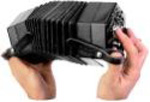 The concertina is by far the daddy of them all in regard to versatility and complexity. Most people identify it as the small instrument 'played by sailors' or, in Australia's case, shearers. In truth it was created to play far more highbrow music and is sympathetic in musical versatility to the violin. In the 19th century it would have sat firmly on the pianofortes or sideboards of the upper class. The concertina is by far the daddy of them all in regard to versatility and complexity. Most people identify it as the small instrument 'played by sailors' or, in Australia's case, shearers. In truth it was created to play far more highbrow music and is sympathetic in musical versatility to the violin. In the 19th century it would have sat firmly on the pianofortes or sideboards of the upper class.
It is an extremely sweet sounding instrument and used to play a variety of music from classical to traditional dance. This article is predominately about the concertina and melodeon in Australia and predominately about their role in traditional music making. 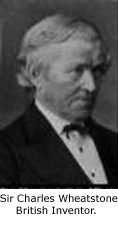 In the 1950s The Ram's Skull Press, Victoria, published a small folio titled 'The Banjo, the Violin & the Bones' where John Manifold discussed the popular instruments of the bush. It should have more appropriately been called 'The Violin, the Concertina & the Melodeon' for these three instruments, along with the harmonica (or mouth organ), were the most commonly played musical instruments in the Australian tradition. In the 1950s The Ram's Skull Press, Victoria, published a small folio titled 'The Banjo, the Violin & the Bones' where John Manifold discussed the popular instruments of the bush. It should have more appropriately been called 'The Violin, the Concertina & the Melodeon' for these three instruments, along with the harmonica (or mouth organ), were the most commonly played musical instruments in the Australian tradition. The concertina was invented in England, around 1830, by Sir Charles Wheatstone, who also pioneered the Telegraph and the appropriately named, Wheatstone Bridge. . The instrument was initially a scientific curiosity until, in 1836, it was marketed as a serious musical instrument, leading to its patent in 1844. By the 1850s the firm of Wheatstone & Co. was manufacturing tenor, bass and baritone versions in two different systems known as the Anglo German and the English. They were hand-made and assembled and, in most models, used the finest timbers, bone and available metals. The first concertina had 48 keys and offered a full chromatic range which made it popular for 'parlour' music and especially light classics and novelty pieces such as 'The Flight of the Bumble Bee' and 'Greensleeves'. 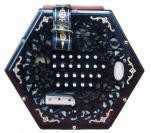 The English 48 button concertina The English 48 button concertinaAs the instrument gained more acceptance, other firms such as Lachenal and Jeffries were established (usually by ex-Wheatstone employees) and the cost of concertinas lowered. With a more affordable price the instrument moved out of the drawing room and into the world of popular music.  The Lachenal logo The Lachenal logo Several new styles were introduced including bass, tenor and baritone instruments. New keyboard systems were also introduced on the theory of 'building a better mousetrap'. Classical music was written especially for the instrument and, especially in England and America, concertina bands were formed. 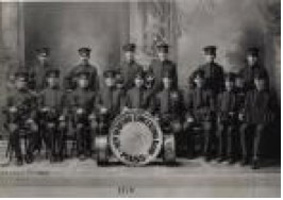 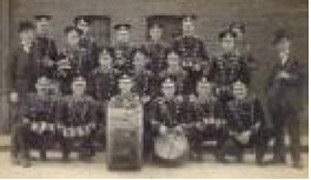 Concertina bands The most successful new style came with the Anglo German concertina, which offered a different note on the push and pull and therefore a completely different sound and playing style. It was also less complicated to manufacture and repair, and was therefore cheaper. It was also easier to learn and play. It's main limitation as that it was restricted in the keys it offered. The most popular was the C/G concertina.  Both the English and Anglo German concertina were extremely popular in 19th century Australia as they were light, relatively affordable, portable and were ideal for dance music and song accompaniment. Both the English and Anglo German concertina were extremely popular in 19th century Australia as they were light, relatively affordable, portable and were ideal for dance music and song accompaniment.
British companies like Lachenal and Wheatstone commenced exporting to Australia very early on in their history supplying an eager market, especially on the gold fields, from the 1850s onwards. There are reports from both the Gulgong and Ophir mining camps of people playing concertina music on the streets and in the hotels. By the 1870s the instrument was well and truly part of our local musical line-up. Australia was built on a mainly male, itinerant workforce. The concertina suited the traveler and it also suited the environment of the bush. It could be played solo or alongside other instruments, it was relatively hardy and remained in tune, and its music echoed the emerging traditional music that was predominantly influenced by English, Scottish and Irish music. It sounded right for the rough and tumble nature of what has become known as Australian bush music. It had the sound of the campfire and seemed comfortable as an accompaniment to campfire conversation and a billy of tea. 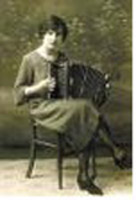 Music was extremely important to the bushman and the settler as it provided a gentleness often missing in outback life. The young women of the homestead were expected to play keyboard but the concertina was more likely to find itself being played by a man more used to shearing sheep, droving cattle or bending barbed wire. Seeing and hearing such men play sweet tunes and songs must have been a dramatic departure and a civilizing tonic for all. Music was extremely important to the bushman and the settler as it provided a gentleness often missing in outback life. The young women of the homestead were expected to play keyboard but the concertina was more likely to find itself being played by a man more used to shearing sheep, droving cattle or bending barbed wire. Seeing and hearing such men play sweet tunes and songs must have been a dramatic departure and a civilizing tonic for all.
The melodeon or button accordion travelled a similar road. The Melodeon was developed from the harmonica and other free reed instruments early in the 19th century. The Melodeon fingering system is still basically the same today, very similar to a Harmonica on the right hand, with a different note on the push & pull of the bellows, and bass notes and chords on the left hand. The instrument has a naturally rhythmic sound, and came to Australia around the same time as the concertina. 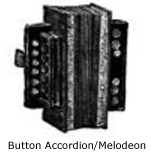 The melodeon was mainly used for playing dance music tunes and was available in one-row and two-row instruments. The basic melodeon has one row of 10 treble keys, and 4 bass keys. The instrument was fairly loud and, with its distinctive pumping action, ideal for dance music. The melodeon was mainly used for playing dance music tunes and was available in one-row and two-row instruments. The basic melodeon has one row of 10 treble keys, and 4 bass keys. The instrument was fairly loud and, with its distinctive pumping action, ideal for dance music.
There is very little documented evidence of traditional players actually singing to the accompaniment of either the melodeon or the concertina. This is primarily because the Australian tradition tends to be an unaccompanied tradition. In the 20th Century, reflecting the massive changes in popular entertainment, the instrument fell out of favour, and one by one, the manufacturers closed or went out of business. Wheatstone's (by this time owned by the music publisher, Boosey & Hawkes) closed in 1968. 
|