
|
[NOTE: in order to read the notes please allow pop-ups for this site]
__________________
|
Chapter 7 - page 4
|
"Barlow's drawing-room entertainment was repeated for the fourth time at The Prince of Wales Theatre last evening, and proved as successful as on the first evening. The entertainment, of its kind, is the best brought under the notice of the Auckland public, and comprises a versatility of talent rarely met with in an evening's amusement. Mr Barlow's name, however, is a sufficient guarantee of excellence; his many years' experience in the profession, and extended fame, serving to ensure crowded houses wherever he goes. As a musician and delineator of character, we have never met his equal, and cannot speak too highly of his singing. He possesses a good voice, full of compass and rich in melody, which, of course, greatly enhances the pleasure of the entertainment. Full of wit and humour, and inimitable in his negro representations, he cannot fail to gain the hearts of his auditors, and is successful in keeping up the interest of the entertainment throughout. The manner in which he acquits himself in every piece is at once convincing of his superior powers to amuse. He commences by singing a negro song, and accompanying himself on the banjo, concluding each verse with a dance. His incidents and songs are in good keeping, and exhibit the superiority of judgment. His "Blue-tailed Fly" is a masterpiece of mimicry, and includes a most natural representation of the buzzing and capture of that insect. The new sensation, "Have you seen the Ghost?" and the "Weepin' Willer," are very entertaining, and always elicit the utmost applause of the audience. His performance on the musical gridiron, which is of a peculiar description, was marked with a finish of execution and command over the instrument quite original. The burlesque solo on the kitchen bellows was equally amazing. In ballads and sentimental ditties of the most varied character, as well as the most whimsical of American melodies, Mr. Barlow is truly wonderful. His negro delineations are the most perfect, and the ease with which he discourses sweet music on the violin, piano, and banjo, and electrifies the audience by producing melody out of the most novel instruments, is something amazing. Nothing could be more enjoyable than an evening with Barlow, and those who hear him once must hear him again." |
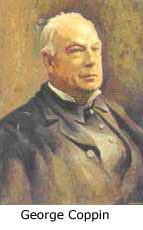
Barlow, never one to stay in one place for long, was back in Victoria by the middle of 1867. He was as popular as ever on the goldfields there. At the end of this year news came to him of the discovery of gold in Queensland, at the place that is now the town of Gympie. Here, surely, in the "Land of Rainbows", was his pot of gold. He arrived there, with his wife and daughter, when Gympie was still a tent city -- as Melbourne had been when he first landed there. His ability to amass a small fortune with his musical talents, was matched as always by a complete lack of luck when it came to gold-mining. He would have done well to heed the advice given to would-be gold-diggers by Coppin's Billy Barlow:
"....stick to the towns and pursue your own trade".
Of course Coppin never heeded his own advice, if he found an opening somewhere that looked promising. And he did, very briefly, try his hand at gold-digging.
There might have been a surplus of gold-seekers in Gympie, but entertainers were few, and Barlow soon cornered that market. In September of 1868, ten months after the discovery of gold, he had built and opened -

 5
5