|
[NOTE: in order to read the notes please allow pop-ups for this site]
__________________
|
Chapter 6: page 3Lola Montez, Billy Barlow, the Tarantula and the Tarantella The years 1855-56 also saw the tour, in Australia, of the beautiful, notorious Lola Montez -- born Maria Dolores Eliza Gilbert in the same year, in the same country, as Gustavus Brooke. The beautiful Lola performed in Melbourne's Theatre Royal, at the time trying to compete, without much success, with Coppin's theatre, where Brooke was playing to crowded houses. 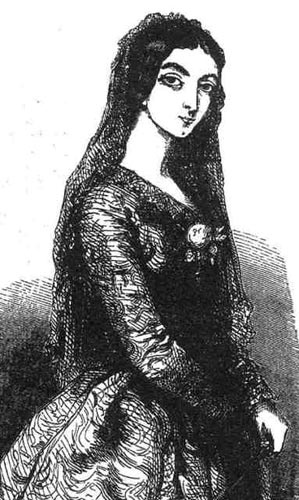
Lola's career had begun after she had spent a short time studying Spanish dancing, and decided that she was really hot-bloodedly Spanish at heart, and not Irish. She romped all over Europe, cracking a whip as a form of crowd control, dancing her highly idiosyncratic interpretive dances. Between dances she treated her audiences to dramatic readings from Shakespeare and others. By the time of her Australian tour she had worked up her famous Spider Dance. Folk-legend in Australia tells us that this dance involved twirling and frantic stamping while the lovely Lola searched for a tarantula hiding in her clothing. The removal of several layers of costume was, she insisted, part of a tasteful and beautiful piece. Sometimes she added more spiders as the mood took her. George Coppin tells it differently. His biographer, Alec Bagot, in a mixture of direct quotes and his own paraphrasing, said that:
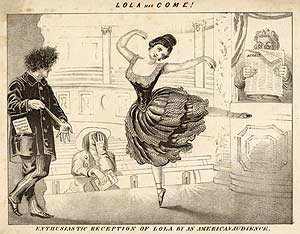 Back in Melbourne, Coppin's Billy Barlow, always ready with a topical routine, danced his own version of the Spider Dance. In a tiny skirt, he twirled and flung himself about the stage. The finale was a spider-chase across the stage, in pursuit of a huge, furry, multi-legged beast that he had produced from beneath his costume. When famed Lola Montez for spiders did look
Coppin toured America in 1864, beginning on the West Coast, from San Francisco to Oregon, and back down to Panama, across to the East Coast, and right on up into Canada. He was with his friend and fellow-actor Edwin Booth when Booth's brother, John Wilkes Booth, shot and killed President Abraham Lincoln. In 1865, Coppin's Billy Barlow said goodbye to New York, and returned home to Melbourne, Australia. Billy Barlow had been a familiar character in America since at least 1832 and, since Sam Cowell's tour there just before the Civil War, he had travelled beyond the cities of the East Coast with the soldiers of the Union Army. The Dodger Song A song connected not with Billy, but with another Coppin character, The Artful Dodge, is a song called, We're All Dodging/ We're All Cheating/ The Dodger Song. The Artful Dodge(r) was of course not Coppin's alone, and is better known as the character in the Dickens story, Oliver Twist. Many comic singers of this time, including Sam Cowell, did "Dodger" routines with singing. Coppin performed a song said to have been of his own composition, in Melbourne in the 1850s, called, We're all Dodging. He may have been using the song well before this. "The Artful Dodge" was an early character of Coppin's, but he was also a character of Sam Cowell's. Both men sang a song about him. No dated, credited copy of the song Coppin sang has so far turned up in either Australia or America, but a song called We're all Cheating has wide currency in Australia, and songs bearing the titles We're All Dodging or The Dodger Song are well-known in America. The American songs date from a period after Sam Cowell's and George Coppin's American tours in the early 1860s. They are usually credited to Oklahoma farmers. It cannot be said with certainty who wrote We're All Dodging but it is possible that it was George Coppin. I don't believe it was Oklahoma farmers.
|

