|
[NOTE: in order to read the notes please allow pop-ups for this site]
__________________
|
Chapter 6: page 2Back to George Coppin George Coppin was right there in the thick of things, and with him, as usual, his most enduring "shabby companion", Billy Barlow. In 1852, right at the beginning of the rush, Coppin walked the lonely miles from Geelong to the Victorian goldfields with his alter ego - Billy Barlow -- for company. Coppin was penniless again, gold-fever having stripped him of the fortune he had made in South Australia. As thousands of South Australians left on overcrowded ships for the port of Geelong, many more simply downed tools, or closed up shop, and set out overland on foot, or on bullock-wagons. There was nobody left who could afford the luxury of a night at the theatre, and no money to be had from any of Coppin's many other enterprises either. The tragic death of his wife Maria, and the loss of his money, had left him in the same condition as when he had first ventured out alone at the age of seventeen. 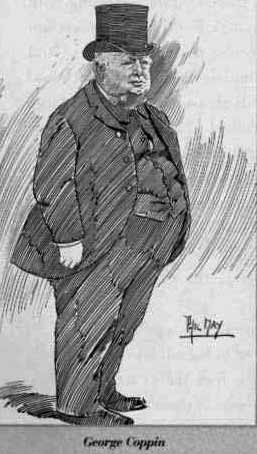 He still had his fiddle and his talents, and, like Billy Barlow, Coppin was never down for long. This episode of absolute poverty, like all the others, lasted only a brief period. Coppin arrived at the goldfields three days after setting out from the Victorian coast. His feet were so swollen that he dared not remove his boots for fear that they wouldn't fit on again. He had no money, and his meagre ration of tea, sugar and flour had run out. Like many other men on the track, he had a gun. It was said that the game was so plentiful that you could easily live off the land. This had of course been true before the arrival of the gold-seekers, when Aboriginal Australians had lived in harmony with this ancient land. Now the land was being cleared and changed at a rapid rate, and any animals or birds that still lived near the roads and settlements stayed wisely out of sight. Some guns were used to great effect as hold-up weapons, but Coppin found that for him the gun was a useless extra weight to carry. Dirty, weary, and disheveled as he was, it took him barely a few hours to find an old friend willing to lend him enough money to buy food. He stayed on the goldfields for two days, blistering his hands and exhausting his body, before realizing that his fortune lay, as it always had, in his talents as a performer. He walked the long road back South until he reached Melbourne. Once again he worked his way up from his penniless state, paying off his debts in Adelaide as he went. It was Billy Barlow and Coppin's old fiddle that drew the crowds into a Geelong theatre, let without security to the trusted George Coppin, that started him on the way up again. After settling his affairs in South Australia, Coppin opened his own theatre in Geelong, and soon audiences laughed and sighed over Billy Barlow at the Goldfields. Another production of Coppin's called: Gold Seekers of Anzasca, using the acronym based on Australia, New Zealand, and Southern California, predates the title "Anzac" used by the Australian and New Zealand armed forces since the First World War. To his theatre in Geelong, Coppin brought actors and entertainers of all types. As well as presenting them there, and in Melbourne, he arranged tours of the Goldfields. Among the many, the blackface minstrel troupe, Rainer's Ethiopian Serenaders, were brought out by him, in 1853, for their first tour of Australia. They were American stars who had already made their mark in the British Isles as well. At least one member of this troupe, leader J C Rainer, stayed on to make his home in the new country. This particular troupe is of interest later as the story of Billy Barlow unfolds. Early in 1854 Coppin's Billy Barlow said goodbye to Victoria again. People had long since lost count of the number of times Billy had said goodbye for ever, but they turned out in large numbers anyway. Throughout that year, as he toured the British Isles, Coppin used the popular Billy Barlow to advise would-be gold-diggers on conditions in Australia. He gave his audiences all their old favourite characters in many skits, but as usual it was Billy they wanted. His Billy Barlow on the Diggings included Billy Barlow's Advice to Emigrants:
Coppin was hailed everywhere as the Australian actor, despite his early successes in his home country. In London the Publication Era said: "Mr. Coppin excels in this style (farce) of representation, and, without being like any of our low comedians, reminds us alternately of Munden, Farren, John Reeve and Liston. His versatility is amazing, and although at times we find ourselves in the company of the great names we have enumerated, we soon find we are with an original, combining the qualities of many." [2] Dublin welcomed him as in the early days of his career and it was noted in the newspapers that Coppin had performed there as Billy Barlow over two-hundred- and-fifty times. Billy had been active in Dublin, during the last decade or so since Coppin's last visit, as the character of other comic actors, but Coppin was a definite favourite there with his long record of appearances.
By 1855 Coppin was back in his beloved adopted country. This time he settled in Melbourne. Whilst in England, he had booked many of the top actors for his Melbourne theatres, arranging their tours of Australia at the same time. Gustavus Vaughan Brooke was to be his star attraction. Born in 1818 in Northern Ireland, and an actor from childhood, Brooke became known for his roles as a Shakespearean tragedian. In London he was seldom considered a great actor by theatre critics, who compared him unfavourably with the well-established Shakespearean actor Edmund Kean. Audiences, however, admired Brooke for his imaginative and idiosyncratic performances and adored him for his handsome Byronic looks and open, friendly personality. 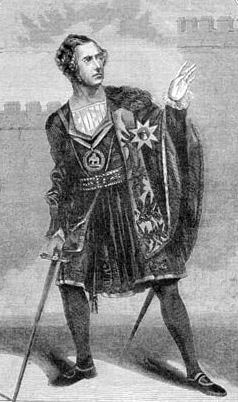 While touring in England, George Coppin had renewed an old friendship with Brooke, and he saw Brooke's potential as a touring actor in the Colonies. Coppin designed, and had prepared, a prefabricated theatre to be shipped to Melbourne in time for Brooke's arrival there. Ultimately, in Melbourne, Coppin and Brooke became close friends and then business partners. Coppin married Brooke's sister, making the two men brothers-in-law as well as in spirit. On the Australian goldfields, and in Melbourne, Brooke was hailed as "The Father of the Drama". The diggers loved him as much as did the respectable theatre-goers in the city of Melbourne. Brooke returned home to England at last, after performing in Sydney before equally enthusiastic audiences. By this time, he had dissolved the partnership with Coppin, left his wife for a pretty young actress, and begun a decline into alcoholism. A decade later, Brooke had patched things up with Coppin, if not his wife, and was persuaded by Coppin to embark on another Australian tour. He was returning to Melbourne without his mistress -- who could not be induced to accompany him -- to appear before his greatest admirers, when Death gave him the greatest part ever given to an actor of tragedy. His audience was small: eighty-two terrified passengers and crew of a doomed ship in the middle of a raging storm in the Bay of Biscay. As the only salvageable lifeboat made ready to pull away with its twenty people, Brooke, manning a pump, was offered a place in the boat. He braced himself against the wind, and, standing there on the deck, (dressed in -- if we can believe the Scottish poet McGonagall -- his Garibaldi jacket and hastily-donned drawers) [3] he delivered his great valediction: "No! No! Goodbye. Should you survive, give my last farewell to the people of Melbourne." Sixty passengers, including Gustavus Vaughan Brooke, were lost at sea when the steamship London sank on its death voyage.
|

