|
[NOTE: in order to read the notes please allow pop-ups for this site]
__________________
|
Chapter 3 - page 2
When the Minstrel Show was about thirty years old, the Civil War focused audience attention on slavery. Actors and singers had always included the songs of the abolitionists and plays about the cruelty of slavery in their repertoires, but many, particularly within the Minstrel Show, had, during the 1830s and 1840s, also portrayed black slaves in a far less sympathetic way. After the Civil War the songs of the blackface minstrels were, in the main, the popular sentimental ones of the day. They were sung by men, including singers of African-American descent, who dressed in formal suits and called themselves Ethiopian Serenaders. It was the Minstrel Show of this later period that specialised in harmony singing. Even before the Civil War, by the 1850s, songwriters, in particular the greatest of all of them, Stephen Foster, wrote their songs from a human perspective, using familiar themes of love, sorrow, marriage, family life, and home. Foster deliberately set out to change the face of the Minstrel Show, instructing performers to treat their characters with dignity and understanding, avoiding the use of comic dialect. Early in his career he himself had used plantation dialect, but he came to understand its dehumanising effect, and his later songs never used it. One of the clues to the reason that the songs of this sensitive and compassionate man are now regarded with such ambivalence may be -- as told by Maurice Willson Disher-- that his songs were labeled "Confederate songs" and claimed by the South at the commencement of the Civil War. Stephen Foster died in New York in 1864 at the age of thirty-seven. He had in his pocket a scrap of paper that bore the penciled words: "Dear friends and gentle hearts." [1]  Punch, a street-performer interviewed by Henry Mayhew, took his name from the Punch-and-Judy show which he operated. He talked about the recent inclusion of Jim Crow in Punch recounted for Mayhew the inspiration for his puppet show which he called: 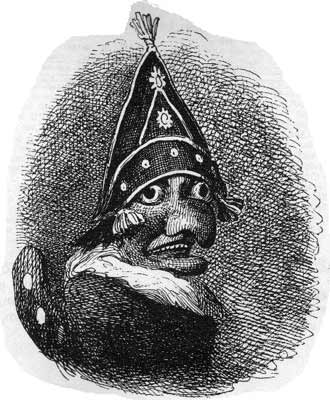
"The Dominion of Fancy or Punch's Opera,". He talked about his love for the theatre and how it formed the basis of his own show. Punch went on to explain his version of the morality play he presented, with his hand-carved wooden puppets, where the killing of a wife and baby leads to hell. Once there, however, Mr. Punch kills the Devil, clearing the way for eternal love and peace. Billy Barlow was never as well known as Jim Crow but he was more enduring. Audiences might be thrilled by exotic one-dimensional characters, but they find it hard to relate to them in a personal way. Jim Crow was never an ordinary man. Never loved as kin. You were never expected to take too much notice of his comments. Billy was able to change with his audiences and with the times: one day an Irish immigrant in Boston, the next an English gold-digger off to Australia, and, when the time was right, a Billy Yank in the Civil War.
|
