[NOTE: in order to read the notes please allow pop-ups for this site]
__________________
|
Chapter 12 - page 2
The fact that Union soldiers were called Billy Yank, (as Southerners were called Johnny Reb), may have reinforced the idea that this other Billy -- Billy Barlow, was one of them. There is a hint that at least one soldier, in a letter to his sweetheart, was using the name Billy Barlow as a generic term, possibly to refer to himself. ".....beautiful sloughs where Billy Barlow will sometimes get stuck in the mud....." He and his fellow soldiers had probably been stuck in the mud often enough. [1]  From the diary of a telegrapher, Drummond, who was captured by the Confederate army in the Shenandoah Valley in 1862, we know that one of Sam Cowell's other songs was well known. Drummond and his fellow prisoners of war had been marching for four days along roads deep in mud. They were in a miserable state, hot and thirsty by day, cold and wet by night. Their rations, except for the officers who could pay for their food at hotels along the way, had consisted of just four hard-tack crackers each, on the second day of their captivity. On the fourth night, this is Drummond's diary entry:
[2] ************************************************************************************ 'Tis the song, the sigh of the hungry: ************************************************************************************
General Francis Channing Barlow 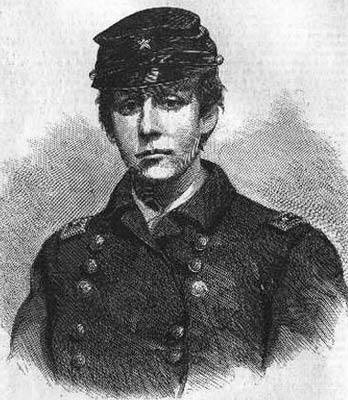
There is a quite famous Billy Barlow who served in the Union army. He was Francis Channing Barlow, a young New York lawyer who was well known for being eccentric in manner of dress and in some of his practices. He was given the nick-name almost certainly because of his family name, but maybe also, when he was in command, as an attempt to make light of the situation in which his men found themselves. As an officer, Francis C. Barlow was a strict disciplinarian. There was probably never a Billy Barlow less like a raggedy happy-go-lucky clown. Barlow enlisted as a private in New York's 12th regiment of the National Guard, at the first call to arms. He had graduated at the head of his Harvard class, and, at twenty-seven, had just begun his career as a Manhattan lawyer. He had no military experience, but seems to have been a born warrior. Extremely intelligent, absolutely fearless in battle, and utterly ruthless in achieving his goals, he quickly rose to the rank of colonel. By an interesting coincidence, Emilie and Sam Cowell watched as the newly-formed New York regiment, in which the then Private Francis C Barlow had just enlisted, paraded below the window of their Broadway hotel. The older, well-established Billy Barlow had a prime spot to view one of his future namesakes. Emilie doesn't give the names of the marches played that day, but the Billy Barlow tune was used by the Union army all through the War, and it's as likely as not that the soon-to-be General Billy Barlow stepped smartly along to a drum-and-fife rendition of it. When Francis C Barlow left New York for this first taste of action, he left behind him his bride of one day, so anxious was he to join the fight. Francis C Barlow was rangy and slim, with a boyishly handsome face that bore a thoughtful and deceptively mild expression. Among the mostly mustached and bearded officers of the time, Barlow stood out with his clean-shaven face. Stage-Billy Barlow, it may be noted, although sometimes showing a bit of stubble, never had a beard. ************************************************************************************ Emilie Cowell tells the story of how once during their tour of the South, her Sam sat in a barber's chair next to Abraham Lincoln. Sam overheard the then-future president tell the barber not to shave his whiskers, but to "Give them a chance to grow." ************************************************************************************
|
