Bondi The citizens of Sydney were fascinated by Bondi as a salt water bathing destination. While ocean pool swimming, with neck to knee bathing attire, was the norm there were alsosome hardy souls who braved the waves and after the establishment of the Life Saving service the idea of sea swimming became incredibly popular. This song is typical of the popular songs written around the turn of the 19th century.
Narrabeen This song was published in the Manly Daily, a large daily newspaper that served the north shore of Sydney. It must be remembered that this newspaper was prior to the establishment of the Sydney Harbour Bridge and the north shore residents relied on local news availability.
Maroubra A song toasting the eastern southern beach of the same name. The songwriter appears to have transposed Maroubra to Hawaii complete with with swaying hula girls.
The Lad on the Man-O'-War
Imperial Songster 85
approx 1905
words and music by Alan M. Rattray and L. L. Howarde
a popular pantomime number
|
|
Emigration Bound
ARGUS ship's newsletter
1862 March � June
Barque 'Colonial Empire' sailing London to Sydney
tune: Old Virginny
|
|
On Sleep
ARGUS ship's newsletter
1862 March � June
Barque 'Colonial Empire' sailing London to Sydney
Nature requires five
Custom gives seven
Laziness takes nine
And wickedness eleven
Our Dirty Second Floor
Tune: Nelly Gray
Note: this song, a parody, appears to be relative of Maggie May
|
|
The Maid Onboard
M3274 NATIONAL MARITIME MUSEUM
A series of handwritten ship's journals 1850s
|
|
The Fisherman's Daughter
M2834 -
NATIONAL MARITIME MUSEUM
1879 sea trip diaries
Note: song roughly hand-written nostalgic song typical of the era
|
|
Outward Bound
SEA BREEZE MAGAZINE
March 1959 � Journal of the Shiplovers' Assoc.
This song comes from the memoirs of Walter Warren (born 1858)
and he learnt it during a voyage from London to New Zealand in 1874
TUNE: Homeward Bound
|
|
The Stokers
Sea Breeze 1959 August quotes this ditty from the steam ship era.
The Captain on the bridge above thinks he owns the show
'Taint he, 'tis the stokers that make the ship to go,
'Tis the grimy, greasy stokers lugging at the skids.
And only getting shillings while the captain he gets quids.
Haul the Bowline
Sea Breeze 1958
Part of a ditty sung on exiting Sydney 1882
|
|
Whaler's Life
Anon 1866 contributed to the Australian Journal by J D of Mount Alexander, Victoria.
|
|
Shanty
From Capt John Williams (born 1896) who had it from his father.
Anchors' Weighed
The tears fall gently from his eye
When last we parted on the shore
And from her lips came many a sigh
To think that I should see her no more
Capstan Shanty
As sung in Melbourne and above reference
Call the hands to man the capstan
See the cable runs down clear
And we'll spread our wings for England
As to England's shores we steer
Cheerily
Memories of Halbert Dickson. Aust Jnl Feb 8/1886
|
|
Halyard: Whiskey Johnee
As sung on board the Dunsyre ( a 3 masted full rigged vessel of 2149 tons and 22 crew.
Source Frank Clune who was a clipper sailor and quoted in land Of My Birth.
Whiskey made a fool of me
Whiskey John- ee
Whiskey made me go to sea
Whiskey for my John- ee
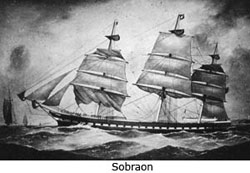 The Homeward Bound was an irregular magazine produced by passengers on board the full-rigged ship 'Sobraon' on a voyage from Australia to the Uk in 1882.
Vol 1 no 2 February, 1882, had the words to the following shanty sung by the crew. The Homeward Bound was an irregular magazine produced by passengers on board the full-rigged ship 'Sobraon' on a voyage from Australia to the Uk in 1882.
Vol 1 no 2 February, 1882, had the words to the following shanty sung by the crew.
Whiskey Johnny
Vol 1 no 2 February, 1882
|
|
Caroline Chisholm
Empire Newspaper Sydney 1862
|
|
Our Captain
Composed by T Perry a sailor on the Resolution (Capt Cook's third voyage)
We were all hearty seamen, no colds did we fear
And we have from all sickness entirely kept clear
Thanks be to our Captain, he has proven good
Amongst all islands to give us fresh food.
Cheer boys cheer
As sung abroad the 'Delta' on voyage to Australia 1852 as recalled by James Robertson
Source: Records of the Castlemaine pioneers.
To the West, To the West
The land of the free.
Also
On the fields of Ballarat
You're scarce allowed to wear a hat
Cheer boys cheer
For this new and happy land
Riverboat Ditty
Quoted in 'River Boat Days of the Murray' Peter Phillips.
Supposedly sung by crewmen.
|
|
The Hot Potato Club
Formed by regular travellers on the Sydney to manly steamer.
Ref: Capt Henderson 1971
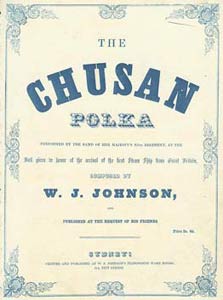
The Chusan Polka
The Aust Journal 1868
A polka created to celebrate the first mail steamer to visit Australia in 1868.
Haul On The Bowline
From Royal Historical Jrn 1909 and sung by whaler men out of Mosman's Bay.
Haul on the bowline
The fore and maintop bowlin'
Haul the bowline, haul
Haul the bowline, the bully bully bowline
Haul the bowline, the bowlin' haul.
Blow the Man Down
From 1914 book on the Aust Steamship Line by RM McDonald who was aboard the Cardinia
|
|
Mr R Hassall of Balgowlah also had a song:
This Bit Of The World Belongs To Us
|
|
How's this for a piece of white supremacy and flag waving! Composed by the
one and only Joe Slater, this song was printed in the Imperial Songster of 1908.
Australia's Welcome To Uncle Sam:
To Honour the American Fleet
IMPERIAL SONGSTER 1908
(Tune: Boys of the USA)
|
|
Mr Roy Liston, Tascott, NSW, recalled the following lines to this popular song:
Boys of the USA, how glad we are to meet you,
Boys of the USA, and proud we are to greet you.
With the Union Jack, the Stars and Stripes and Southern Cross unfurled,
We will show the foe, we can hold our own in this wide, wide world.
Going from references in other publications it appears there was a popular series of glass slides on Manly and the following song. It must have been a popular song as I have had several elderly Sydneysiders sing parts of the chorus.
Take Me Down The Harbour
Gray & Bennett. Tivoli Pub.
Imperial Songster No 83 1909
|
|
All Aboard for Manly Beach
|
|
To Manly (and other places)
(Parody " The Bowery.'')
|
|
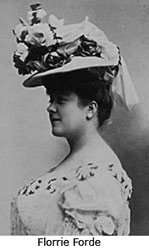
The Imperial Songster No 14 points to Ms Florrie Forde St Clair as the singer of this next song. Florrie Forde was born in Victoria and became the most famous music hall chorus singer in the world. She dropped the 'St Clair' after moving to London. Florrie had a great, large, fruity voice and I can well imagine her belting this song out. Those interested in Australian stars of the international music hall should refer to the section of this site 'Recordings � Yesterdays Australia' where I produced two wonderful CDs of these artists including tracks by Florrie Forde. Incidentally, her best known songs were 'Tipperary' and 'Goodbye-ee', both synonymous with WW1
Manly Was The Place (or, Monday Was the Day)
IMPERIAL SONGSTER No 14
|
|
'ORROR UPON 'ORRORS 'EAD
SYDNEY PUNCH
JULY 17. 1869
(TUNE: THE CORK LEG'
first line: A story I'll tell without any fear
In this next song, a familiar sailor story, yet unusual to find in Australia, our 'Jack' is led astray. The P.C. refers to the Police Court.
Jack Ashore
Air: Derry Down
|
|
Joseph Bradley sailed to Australia on the 'Lynx', an active whaling ship. It is mentioned that the crew sang this song on the voyage.
The Neglected Tar
ADVENTURES OF A NATIVE OF AUSTRALIA
Joseph Bradley
C 1860
Mitchell.
|
|
There seems to be many sentimental songs about saving ones mate � some came from the goldrushes like 'Mines Of Australia' and this one is set in a shipwreck.
Shipmates
Australian Melodist No 20
Mitchell library 784.8/A
|
|
Ship's Departure
Composed on Capt Phillips departure with the first fleet and published in the Whitehall Evening Post
They go off to an island to take special charge
Much warmer than Britain and ten times as large
No custom-house duties, no freight to pay
And tax free they'll live when at Botany Bay
SEA SHANTIES SUNG OF THE SS NORTHUMBERLAND
During a voyage to Melbourne 1882
From 'Back Country' or the Cheerful Adventures of a bush parson in the eighties'
J W Eisdell. 1936
The following song is a version of 'Queer Bungle Rye' and a familiar story for sailors ashore.
Two shanty fragments as sung on the sailing ships bringing gold seekers to Sydney in the 1850s. Found in Adventures on the Australian Gold Fields
- W Craig. 1903
Pumping Shanty
Oh fare you well, my own Mary Anne
Fare you well for awhile.
Anchor Hauling Shanty
When first we went a-waggoning
Drive on my lads, heigh ho.
When Jones' Ale Was New
Hope Yarns, Marlin Spikes & Tar
W E Dexter
1938
(Tune: When Jones' Ale Was New)
|
|
Shanghai Brown
A shanty indicated as sung on the Australian/London route.
Morn Of Youth
Robert S Close
1949
(Tune: Shallow Brown)
Shanghai Brown has gone aloft
On the royal mainyard you'll find him
In a split tailed coat buttoned up to his throat
And his spit kid hanging behind him.
Broadside pasted in front of ship's log book.
The barque 'Duchess of Northumberland (1850-1888) under Captain George Mitchell.
The broadside was printed by Walker of Durham, UK.
This is a classic sea song. This version is not in either the Hugh Anderson or Ron Edwards collections
And is different from the Peter Kennedy UK version.
Lovely Nancy
Broadside circa 1850-1888
Printed Walker of Durham, England.
Coupled with The Sailor's Farewell.
|
|
Excursions & Adventures in NSW
Capt Henderson 78th Highlanders
London Vole 1 & 2
1854
DSM/981/37B Vols. 1 & 2
Being a Guide to Emigrants.
On the ship Fortune from Scotland to Sydney.
Note that this is an extract from a large book and interested readers should refer to the 'Emigration' section where additional Capt Henderson material can be found including his version of The Immigrant's Lament'
This being Saturday night we had a merry party in the cuddy to drink the usual toast of 'sweethearts and wives'. As it was the first convivial meeting of the kind, it was kept up with spirit, and many a good song was sung, not forgetting the appropriate one ending with the lines �
Now we sail with the gale,
From the Bay of Biscay-O
There being eight or ten bachelors among us, besides tow or three very merry Benedict's, the party did not break up till a late hour, after coming to the resolution of repeating the performance hebdomadally. The following song, a joint composition arising out of the proceedings of this evening, and sung at the succeeding Saturday night's merry-making, may not be unacceptable, as showing that there may be some fun on board ship to while away the time during so long a voyage �
The Captain was a pleasant little man enough, and wore a fiery red tartan cloak in rough weather. He could sing too: but he was a man of one song, and that song was, 'The Hapless Cabin Boy' performed regularly every Saturday night in a sentimental manner to a right melancholy air; and for this reason, he generally obtained the sobriquet of the 'Hapless Cabin Boy.'
The Wonderful Crocodile
I first came across this song in a Bush Music Club songbook and started to sing it ten years later. I recorded a version on 'Limejuice and Vinegar' (EMI and later reissued Larrikin). Kids love this story and so do I. I love the mention of la Perouse and was delighted to see it in print.
|