|
|
WATTLE DAY 1st August The sweet Australian Wattle is the emblem of our land,
You can stick it in a bottle, or hold it in your hand. (I'm not sure where I got the above ditty from but it smacks of comedian Barry Humphreys) On September 20, 1889 William Sowden, later to be knighted, an Adelaide journalist and Vice President of the Australian Natives Association in South Australia suggested the formation of a Wattle Blossom League. Its aims, set down in 1890, were to "promote a national patriotic sentiment among the woman of Australia". One way of doing this was to wear sprigs of wattle on all official occasions. After an enthusiastic start the group folded. However, their presence inspired the formation of a Wattle Club in Melbourne. During the 1890s parties were led into the country on September 1 each year to view the wattles.  The concept of Wattle Day grew stronger and spread to NSW where the Director of the Botanic Gardens, J H Maiden called a public meeting on August 20, 1909 with the aim of forming a Wattle Day League. As a result of this meeting the first Wattle day was held on September 1, 1910 in Sydney, Melbourne and Adelaide. On that day the Adelaide committee sent sprigs of Acacia pycnantha to the Governor of the state of South Australia. It was this wattle that became accepted as the official floral emblem. The concept of Wattle Day grew stronger and spread to NSW where the Director of the Botanic Gardens, J H Maiden called a public meeting on August 20, 1909 with the aim of forming a Wattle Day League. As a result of this meeting the first Wattle day was held on September 1, 1910 in Sydney, Melbourne and Adelaide. On that day the Adelaide committee sent sprigs of Acacia pycnantha to the Governor of the state of South Australia. It was this wattle that became accepted as the official floral emblem.Celebration of Wattle Day reached its height during World War 1. The day was used to raise funds for the war effort and many trees were denuded in order to supply the many sprigs of wattle sold on that day. Boxes of wattle were sent to soldiers in hospitals overseas and it became a custom to enclose a sprig of wattle with each letter to remind our soldiers of home. After the war Wattle Day was kept alive in schools. In 1917 however the date of Wattle Day was changed to August 1, for convenience, as that year had an early spring! In 1937 another date change, this time back to September 1st as this was the start of the school holidays! Now as every one knows Wattle Day is officially September 1st. The Spicer's desk calendar has the following quote for September 1st this year "The soft golden wattle blooms brightly in Spring; So why do we still call the daffodil, King?" EMPIRE DAY May 24 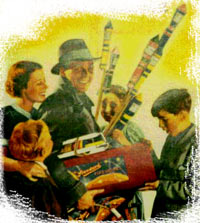 As a kid at school in the 1950s we used to celebrate Empire Day. The most notable event on the day was the appearance of a brightly coloured aluminium bottle top, bearing the British Union Jack, on our free school milk. To us the day was closely associated with Bonfire Night. WF As a kid at school in the 1950s we used to celebrate Empire Day. The most notable event on the day was the appearance of a brightly coloured aluminium bottle top, bearing the British Union Jack, on our free school milk. To us the day was closely associated with Bonfire Night. WF
BONFIRE NIGHT or CRACKER NIGHT 5th November. When I was a kid in the 1950s Bonfire or Cracker night was one of the highlights of the year. It was customary for the children of the street to build a bonfire out of just about anything flammable. There was great rivalry between streets to see who could build the most impressive bonfire. We lived on the beach at Brighton-le-sands and the entire strip of the beach was dotted with bonfires, often over ten metres tall. We also added a 'Guy Fawkes' effigy to the top, often in an old wooden chair. The bonfires were guarded and everyone dreaded the possibility of sabotage � a premature burning in the middle of the night. When the big night came all the kids brought their bags of crackers and the whole beach had a party atmosphere that is missing in these later days.  GUY FAWKES DAYCracker night was also celebrated with pranks � especially placing 'double bungers' (an extremely loud firework) in letterboxes. One unsavoury prank involved placing dog poo in a brown paper bag, placing it on someone's doorstep, lighting the paper and then ringing the doorbell. The theory being that the householder would open the door, see the burning bag and stomp on it (and the dog poo). Argh childhood fun! - WF GUY FAWKES DAYCracker night was also celebrated with pranks � especially placing 'double bungers' (an extremely loud firework) in letterboxes. One unsavoury prank involved placing dog poo in a brown paper bag, placing it on someone's doorstep, lighting the paper and then ringing the doorbell. The theory being that the householder would open the door, see the burning bag and stomp on it (and the dog poo). Argh childhood fun! - WF
Oh please remember the 5th of November Gunpowder treason and plot I have no reason why gunpowder treason Should ever be forgot Holler boys, holler boys God save the king Holler boys holler boys God save the queen. From R Ridley's grandmother. From The Sydney Illustrated News Nov 1867. "Considerable amusement was erected on Guy Fawkes Day by the appearance of five guys in costumes to represent the Windsor uniform and one female being placed in front of Parliament House � about the time the members were assembling for business. The ragged brigade were marshalled by the Flying Pieman who was evidently coached for the occasion and delivered what he called a political oration portion of which ran thus� ARBOR DAY 20 June Arbor Day in Australia was first observed on 20 June 1889, in Adelaide, and was organised by Mr J. Ednie-Brown, the South Australian Woods and Forests Department's first conservator. In Ednie-Brown's 1896-97 Annual Report, as conservator of the West Australian Woods and Forests Department, he mentions the supply of surplus seedlings for various purposes, including Arbor Day. In Victoria, it was first observed in 1909. In Western Australia, the celebration of this day was provided for in the Forests Act 1919 and now the Conservation and Land Management Act 1984. The date for its celebration is fixed each year by the Minister for Conservation and Land Management to coincide with the Day of Trees during Western Australia Week. MAY DAY May 1st In 1884, the 1st of May 1886 had been chosen as the day the Federation of Organised Trade and Labour Unions of the United States and Canada had earmarked "as the date from and after which eight hours shall constitute a legal days labour". On the 1st May 1886, Australia's first anarchist organisation was formed - The Melbourne Anarchist Club. MAY DAY SWEEP'S PARADE It was common for Sydney and Melbourne sweeps to have a May Day procession of sweeps who carried a well-blackened individual in a sedan chair covered with bushes � tea tree or kunzia � this was their Jack in the Green. Coins were gratefully accepted from the crowds and used to buy ale after the procession. May Day is celebrated in Australia as a commemoration of Labour and the eight-hour day. It is celebrated by a city street march. Some unions produced colourful folk-style banners. The maritime unions were particularly interesting. FRIDAY 13th This day appears with regularity and has always been associated with bad luck. This superstition dates to the number 13 being generally seen as unlucky. It originates with the Last Supper having 13 at the table.
AUSTRALIAN HOLIDAYS These are sometimes referred to as 'bank holidays' as the banking institutions, and most other government and major corporate entities, are closed for business. Sometimes certain holidays are celebrated on different dates, depending on the State or Territory. LABOUR DAY Introduced in 1871, celebrates the eight-hour working day. In NSW it is held on the 1st October each year. AUSTRALIA DAY. 26th January. Celebrates the foundation of Australia. QUEEN'S BIRTHDAY June 8th each year. Refers to the current Queen of England. EASTER There are several 'Holy Days' celebrated at Easter including Good Friday. Custom has developed to give gifts of chocolate Easter Eggs. For NSW Easter is associated with the Royal Agricultural Show which is known as 'The Show' or 'Easter Show'. CHRISTMAS Another Christian festival period celebrated with gift-giving and associated foods NEW YEAR Australians traditionally celebrate New Year's Eve with a countdown to the stroke of midnight. Auld Lang Syme is sung at such occasions and often with linked hands signifying unity. ST ANDREW'S DAY November 30 ST PATRICK'S DAY March 17th. Traditionally celebrated with a meal of corned beef and cabbage. Irish pubs in Australia also offer 'Irish Stew' and peculiar things like 'Green coloured beer'. REMEMBRANCE DAY November 11th NATIONAL SORRY DAY January 26th has been designated National Sorry Day as opposed to the Australia Day celebrated be a public holiday. It takes its name from the Prime Minister's refusal to say 'sorry' to the indigenous people of Australia for a litany of wrongs. SCHOOLIES WEEK Differs by State however it coincides with the end of November. This appears to be a relatively new celebration and coincides with the end-of-school for final year students. MOTHER'S DAY May 13th celebrates the role of mothers and it is customary to give white flowers and presents. FATHER'S DAY September 9th celebrated with gifts. HORSE'S BIRTHDAY 1st August. Traditionally the birthday of all horses. QUEEN'S BIRTHDAY Although the British celebrate the Queen's birthday on April 21st Australians celebrate it on June 8th. ANZAC DAY 25th April. Commemorating Australia's history in war. The dawn Service and parade are important parts of this annual event. Two-up, the game of tossing heads or tails (coins) is legal on this day. APRIL FOOL'S DAY 1st April. Traditionally this day is celebrated with pranks known as 'April Fool's Pranks'. A typical prank would be a message to call back Mr Lyon � when the call is placed it turns up to be the local zoo. HOLLOWEEN 31st October. The day of the dead. This American custom has now installed itself in the Australian calendar and on that eve small children dress in ghoulish costume and door knock. It is customary to give the kids lollies. |