SECTION 19: Popular Entertainment
Blondin
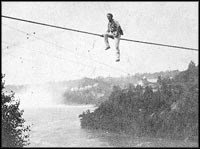 In the later half of the nineteenth century 'spectaculars' became an important part of popular entertainment. No doubt at lot of this interest is attributable to the popularity of the circus and P T Barnum in particular. One of the most successful international artists to visit Australia was the Great Blondin who was billed as the Greatest Tightrope Walker Ever. He inspired record crowds, lore and songs. In the later half of the nineteenth century 'spectaculars' became an important part of popular entertainment. No doubt at lot of this interest is attributable to the popularity of the circus and P T Barnum in particular. One of the most successful international artists to visit Australia was the Great Blondin who was billed as the Greatest Tightrope Walker Ever. He inspired record crowds, lore and songs.
He was the first man to walk across Niagra Falls. In August 29 he walked across high wires strung across the Sydney Domain.
I have seen references to songs on his feats and I am chasing these for inclusion. He also appeared at Coogee Beach which was a popular seaside entertainment area
Billy Barlow
Music hall song as sung by George Coppin in 1843 at the Victoria Theatre.
|
|
This doesn't appear to be related to the usual Billy Barlow songs and, I suspect, Billy Barlow was a familiar characterisation of a new settler in the same mould at Bill Muggins was in the mining industry.
George Coppin was one of the early colony's most successful stage actors and singers.
Billy Barlow
Australian Melodist Songster
|
|
There are several Billy Barlow songs and I would refer readers to the index where I have collected two other, completely different, ballads about Mr Barlow. One assumes Billy Barlow was like Bill Muggins and an 'everyman' description of new chums.
Jenny Lind
HEADS OF THE PEOPLE Magazine 1848
|
|
Jenny Lind (Goldschmidt), (born Stockholm 1820 died London 1887) was known as the 'Swedish Nightingale' or 'The World's Sweetest Singer'.
A star attraction for P T Barnum her New York arrival in 1850 saw over 40,000 greet her followed by sell out concerts.
One of her most popular songs was 'Home Sweet Home' which might tell something of her huge Australian success with miners in the 1850s when she toured here.
Proof of her appeal is in the number of things named in her honour including ships,. baby cribs, hotels, schools, lamp bases and even a soup (quoted in Ulysses by James Joyce: sage, stock, raw eggs and half a pint of cream). Hans Christian Anderson proposed to her as did Czar Nicholas of Russia. |
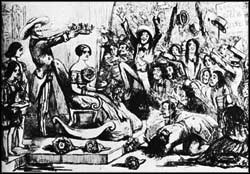
from the1850 British magazine Punch, satirizing the American commotion over Jenny Lind |
From my view the greatest honour was a polka well known throughout the world, including the bush, as the Jenny Lind Polka. I was, of course, thrilled to locate a song about Ms Lind and the commotion she made.
Some of the song reference appear lost in time. Possibly the 'opear's' is meant to be 'opera's'? The song can be dated by the fact Ms Lind had not married her American husband at the time of publication. The song must have been before her visit to Australia considering the date of the magazine.
Lola Montez
THE NIGHT LOLA MONTEZ PLAYED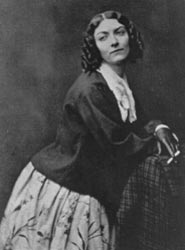 Fragment
And many a bearded digger bold
In scarlet shirts arrayed
Assembled in the house the night
Lola Montez played
Quoted in an article 'a pair of pistols – an actors story' in Wattle Blossom magazine 1881
LOLA MONTEZ
Erle Seekamps face wore a bloody trace
Of Lola Montez's lash
Her shoulder fair it was bare
Would show a crimson gash
When Lola M challenged a newspaper Editor to a stockwhip cracking contest in the bar of the United Services Hotel Ballarat 1855
The Lenton Troupe
(Performing 1865)
An advertisement:
Pro Marley: Great unrivalled delineator of Negro eccentricities with Senor Ferrari and his talented troupe of trained monkeys. Prince of Wales Theatre
amusements � a review
june 1878 Evening Star
Mr Houdin, as he calls himself, performs some of his tricks very well. Mr. Searell is a fair pianist. Both these gentlemen have lately occupied the stage in White's Rooms, but the audience has not been very large. Mr. Houdin may be a relation of the great French conjurer, but he strikes us as being unmistakable Cockney, with a horribly bad French accent. His use of the letter 'h' needs improving, it is not correct to say "May I (h) ask you to 'old this (h) egg in your 'and"
Old Bob Ridley
A minstrel song that has entered the local tradition.
|
|
Ben Bolt
Australian Melodist Songster
|
|
Above is the original song that became a very popular parody vehicle. It is obviously a minstrel song but the traditional version take it left, right and centre. Refer to Australian Folklore Unit (Jack Pobar) for a traditional version.
I have collected versions of Ben Bolt as Sam Holt and also as parody. Here's another parody of this popular song.
To The West! To The Land Of The Free!!
Australian Melodist Songster
|
|
I was interested to see this song, a minstrel song, in a popular songster published in Melbourne. My main interest is that I and other collectors have recorded parodies of this song.
Toor-Ral, Li-Ooral, Li-Addity.
Australian Melodist Songster
|
|
This is an early printed version of the well-known 'Botany Bay' however, in the songster, it appeared under the title of 'Too-ral, li-ooral, Li-addity'. The songster had the song divided into scenes and I have kept the headings in the transcript. The sections of the song may have been illustrated in live performance by a notice bard or even a series of illustrated slides.
My Grandmother's Watch
SAM SLICK MAGAZINE
OCT 1879
(Tune: My Grandfather's Watch)
|
|
Here's a delightful song inspired by the craze for dance palaces and music hall entertainment and, in this case, Melbourne.
Sally Bain
(or, De Nigger Digger's Lament)
THE ARMCHAIR
MAGAZINE
Published Melbourne 1853
also appears as Armchair Chronicle
(Tune: yeller Girl)
|
|
This item shows that the 'nigger minstrel' shows must have come to Australia very early as this parody is based on a well-known minstrel song and I have located similar parody songs from that time.
A Song of Victoria,
THE ARMCHAIR
MAGAZINE
Published Melbourne 1853
also appears as Armchair Chronicle
On the occasion of the departure from her shores of many of her old colonialists
(Air: Here's to the Maiden of Bashful Fifteen.)
|
|
The Old Folks at Home
Another minstrel song parody
(Tune: The Old Folk At Home)
|
|
Dree Tousand Miles Away
SILVER Songster 1908
(Tune: Ten Thousand Miles Away)
|
|
This is what was known as 'Dutch Parody' and done in an accent.
It was sometimes sung with what was known as a 'treadmill step' that was a windmill dance step parody!
When the Hardest Work is Over, Jessie Dear
(Parody: When The Sheep are in the Fold, Jessie Dear)
|
|
Two Little Girls In Blue
(Parody: Two Little girls In Blue)
|
|
Sally in the Ballet
AUSTRALIAN MELODIST NO 21
(Parody: "Sally in Our Alley")
|
|
The original song was a typical sentimental favourite, along with ballads like 'The Luggage Van Ahead' and 'Old Shep'. It's great to see a parody even if the singer needs to be well-versed in the tune to get the verses out.
Don't Drown My Father's Rabbit in the Sale
(Parody on "Save My Mother's Picture from the Sale.")
|
|
A nonsense song. Probably early Australian music hall
Scotch Burgoo and Irish Stew
(Air�" Castles in the Air.")
AUSTRALIAN MELODIST NO 21
Written by LANCE LENTON.
Sung by T. C. CALLAGHAN
AND FRANK M. CLARKE
|
|
|
|